Structure factor
In condensed matter physics and crystallography, the static structure factor (or structure factor for short) is a mathematical description of how a material scatters incident radiation. The structure factor is a critical tool in the interpretation of scattering patterns (interference patterns) obtained in X-ray, electron and neutron diffraction experiments.
Confusingly, there are two different mathematical expressions in use, both called 'structure factor'. One is usually written S(q){displaystyle S(mathbf {q} )}


The static structure factor is measured without resolving the energy of scattered photons/electrons/neutrons. Energy-resolved measurements yield the dynamic structure factor.
Contents
1 Derivation of S(q){displaystyle S(mathbf {q} )}
2 Perfect crystals
2.1 Definition of Fhkl{displaystyle F_{hkl}}
2.2 Units
2.3 Examples of Fhkl{displaystyle F_{hkl}}
2.4 Perfect Crystals in One and Two Dimensions
3 Imperfect crystals
3.1 Finite size Effects
3.2 Disorder of the first kind
3.3 Disorder of the second kind
3.3.1 Finite crystals with disorder of the second kind
4 Liquids
4.1 Ideal gas
4.2 High-q{displaystyle q}limit
4.3 Low-q{displaystyle q}
4.4 Hard-sphere liquids
5 Polymers
6 See also
7 Notes
8 References
9 External links
Derivation of S(q){displaystyle S(mathbf {q} )}
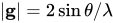
Consider the scattering of a beam, wavelength λ{displaystyle lambda }







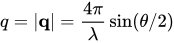

For an assembly of atoms, fj{displaystyle f_{j}}

I(q)=Ψs(q).Ψs∗(q)=∑j=1Nfje−iq⋅Rj×∑k=1Nfkeiq⋅Rk=∑j=1N∑k=1Nfjfke−iq⋅(Rj−Rk){displaystyle I(mathbf {q} )=Psi _{s}(mathbf {q} ).Psi _{s}^{*}(mathbf {q} )=sum _{j=1}^{N}f_{j}mathrm {e} ^{-imathbf {q} cdot mathbf {R} _{j}}times sum _{k=1}^{N}f_{k}mathrm {e} ^{imathbf {q} cdot mathbf {R} _{k}}=sum _{j=1}^{N}sum _{k=1}^{N}f_{j}f_{k}mathrm {e} ^{-imathbf {q} cdot (mathbf {R} _{j}-mathbf {R} _{k})}}
(1)

The structure factor is defined as this intensity normalized by 1/∑j=1Nfj2{displaystyle 1/sum _{j=1}^{N}f_{j}^{2}}
S(q)=1∑j=1Nfj2∑j=1N∑k=1Nfjfke−iq⋅(Rj−Rk){displaystyle S(mathbf {q} )={frac {1}{sum _{j=1}^{N}f_{j}^{2}}}sum _{j=1}^{N}sum _{k=1}^{N}f_{j}f_{k}mathrm {e} ^{-imathbf {q} cdot (mathbf {R} _{j}-mathbf {R} _{k})}}
(2)

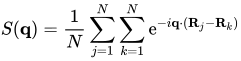
If all the atoms are identical, then Equation (1) becomes I(q)=f2∑j=1N∑k=1Ne−iq⋅(Rj−Rk){displaystyle I(mathbf {q} )=f^{2}sum _{j=1}^{N}sum _{k=1}^{N}mathrm {e} ^{-imathbf {q} cdot (mathbf {R} _{j}-mathbf {R} _{k})}}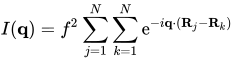
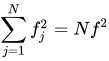
S(q)=1N∑j=1N∑k=1Ne−iq⋅(Rj−Rk){displaystyle S(mathbf {q} )={frac {1}{N}}sum _{j=1}^{N}sum _{k=1}^{N}mathrm {e} ^{-imathbf {q} cdot (mathbf {R} _{j}-mathbf {R} _{k})}}
(3)
Another useful simplification is if the material is isotropic, like a powder or a simple liquid. The intensity then depends on q=|q|{displaystyle q=|mathbf {q} |}
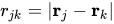
S(q)=1∑j=1Nfj2∑j=1N∑k=1Nfjfksin(qrjk)qrjk{displaystyle S(mathbf {q} )={frac {1}{sum _{j=1}^{N}f_{j}^{2}}}sum _{j=1}^{N}sum _{k=1}^{N}f_{j}f_{k}{frac {sin(qr_{jk})}{qr_{jk}}}}
(4)
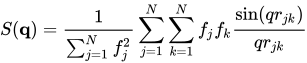
An alternative derivation gives good insight, but uses Fourier transforms and convolution. To be general, consider a scalar (real) quantity ϕ(r){displaystyle phi (mathbf {r} )}




ϕ(r)=∑j=1Nf(r−Rj)=f(r)∗∑j=1Nδ(r−Rj){displaystyle phi (mathbf {r} )=sum _{j=1}^{N}f(mathbf {r} -mathbf {R} _{j})=f(mathbf {r} )ast sum _{j=1}^{N}delta (mathbf {r} -mathbf {R} _{j})}
,
(5)
with Rj,j=1,…,N{displaystyle textstyle mathbf {R} _{j},j=1,,ldots ,,N}
I(q)=|f(q)|2×(∑j=1Ne−iq⋅Rj)×(∑k=1Neiq⋅Rk)=|f(q)|2∑j=1N∑k=1Ne−iq⋅(Rj−Rk){displaystyle I(mathbf {q} )=left|f(mathbf {q} )right|^{2}times left(sum _{j=1}^{N}mathrm {e} ^{-imathbf {q} cdot mathbf {R} _{j}}right)times left(sum _{k=1}^{N}mathrm {e} ^{imathbf {q} cdot mathbf {R} _{k}}right)=left|f(mathbf {q} )right|^{2}sum _{j=1}^{N}sum _{k=1}^{N}mathrm {e} ^{-imathbf {q} cdot (mathbf {R} _{j}-mathbf {R} _{k})}}
.
(6)
This is clearly the same as Equation (1) with all particles identical, except that here f{displaystyle f}
In general, the particle positions are not fixed and the measurement takes place over a finite exposure time and with a macroscopic sample (much larger than the interparticle distance). The experimentally accessible intensity is thus an averaged one ⟨I(q)⟩{displaystyle textstyle langle I(mathbf {q} )rangle }

S(q)=1N⟨∑j=1N∑k=1Ne−iq⋅(Rj−Rk)⟩{displaystyle S(mathbf {q} )={frac {1}{N}}leftlangle sum _{j=1}^{N}sum _{k=1}^{N}mathrm {e} ^{-imathbf {q} cdot (mathbf {R} _{j}-mathbf {R} _{k})}rightrangle }
.
(7)
Perfect crystals
In a crystal, the constitutive particles are arranged periodically, with translational symmetry forming a lattice. The crystal structure can be described as a Bravais lattice with a group of atoms, called the basis, placed at every lattice point; that is, [crystal structure] = [lattice] ∗{displaystyle ast }
In principle the scattering factor S(q){displaystyle S(mathbf {q} )}
I(q)=f2|∑j=1Ne−iq⋅Rj|2{displaystyle I(mathbf {q} )=f^{2}left|sum _{j=1}^{N}mathrm {e} ^{-imathbf {q} cdot mathbf {R} _{j}}right|^{2}}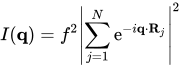
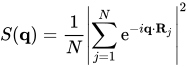
The structure factor is then simply the squared modulus of the Fourier transform of the lattice, and shows the directions in which scattering can have non-zero intensity. At these values of q{displaystyle mathbf {q} }
Definition of Fhkl{displaystyle F_{hkl}}
In crystallography, the basis and lattice are treated separately. For a perfect crystal the lattice gives the reciprocal lattice, which determines the positions (angles) of diffracted beams, and the basis gives the structure factor Fhkl{displaystyle F_{hkl}}
Fhkl=∑j=1Nfje[−2πi(hxj+kyj+lzj)]{displaystyle F_{hkl}=sum _{j=1}^{N}f_{j}mathrm {e} ^{[-2pi i(hx_{j}+ky_{j}+lz_{j})]}}
.
(8)
where the sum is over all atoms in the unit cell, xj,yj,zj{displaystyle x_{j},y_{j},z_{j}}



Fhkl{displaystyle F_{hkl}}


Again an alternative view using convolution can be helpful. Since [crystal structure] = [lattice] ∗{displaystyle ast }


Units
The units of the structure-factor amplitude depend on the incident radiation. For X-ray crystallography they are multiples of the unit of scattering by a single electron (2.82×10⁻¹⁵{displaystyle times 10^{-15}}

WARNING As defined above, the magnitude of the wave vectors |k|=2π/λ{displaystyle |mathbf {k} |=2pi /lambda }



Examples of Fhkl{displaystyle F_{hkl}} in 3-D
Face-centered cubic (FCC)
The FCC lattice is a Bravais lattice, and its Fourier transform is a body-centered cubic lattice. However to obtain Fhkl{displaystyle F_{hkl}}
Fhkl=f∑j=14e[−2πi(hxj+kyj+lzj)]=f[1+e[−iπ(h+k)]+e[−iπ(k+l)]+e[−iπ(h+l)]]=f[1+(−1)h+k+(−1)k+l+(−1)h+l]{displaystyle F_{hkl}=fsum _{j=1}^{4}mathrm {e} ^{[-2pi i(hx_{j}+ky_{j}+lz_{j})]}=fleft[1+mathrm {e} ^{[-ipi (h+k)]}+mathrm {e} ^{[-ipi (k+l)]}+mathrm {e} ^{[-ipi (h+l)]}right]=fleft[1+(-1)^{h+k}+(-1)^{k+l}+(-1)^{h+l}right]}
![{displaystyle F_{hkl}=fsum _{j=1}^{4}mathrm {e} ^{[-2pi i(hx_{j}+ky_{j}+lz_{j})]}=fleft[1+mathrm {e} ^{[-ipi (h+k)]}+mathrm {e} ^{[-ipi (k+l)]}+mathrm {e} ^{[-ipi (h+l)]}right]=fleft[1+(-1)^{h+k}+(-1)^{k+l}+(-1)^{h+l}right]}](https://wikimedia.org/api/rest_v1/media/math/render/svg/5289fff4840feb460de29f7154b583943703ff50)
with the result
Fhkl={4f,h,k,l all even or all odd0,h,k,l mixed parity{displaystyle F_{hkl}={begin{cases}4f,&h,k,l {mbox{all even or all odd}}\0,&h,k,l {mbox{mixed parity}}end{cases}}}

The most intense diffraction peak from a material that crystallizes in the FCC structure is typically the (111). Films of FCC materials like gold tend to grow in a (111) orientation with a triangular surface symmetry. A zero diffracted intensity for a group of diffracted beams (here, h,k,l{displaystyle h,k,l}
Diamond Crystal Structure
The Diamond cubic crystal structure occurs in diamond (carbon), most semiconductors and tin. There are 8 atoms in the cubic unit cell. We can consider the structure as a simple cubic with a basis of 8 atoms, at positions
xj,yj,zj=(0, 0, 0)(1/2, 1/2, 0) (0, 1/2, 1/2)(1/2, 0, 1/2)(1/4, 1/4, 1/4)(3/4, 3/4, 1/4) (1/4, 3/4, 3/4)(3/4, 1/4, 3/4){displaystyle {begin{aligned}x_{j},y_{j},z_{j}=&(0, 0, 0)&(1/2, 1/2, 0) &(0, 1/2, 1/2)&(1/2, 0, 1/2)\&(1/4, 1/4, 1/4)&(3/4, 3/4, 1/4) &(1/4, 3/4, 3/4)&(3/4, 1/4, 3/4)\end{aligned}}}

But comparing this to the FCC above, we see that it is simpler to describe the structure as FCC with a basis of two atoms at (0, 0, 0) and (1/4, 1/4, 1/4). For this basis, Equation (8) becomes:
Fhkl(basis)=f∑j=12e[−2πi(hxj+kyj+lzj)]=f[1+e[−iπ/2(h+k+l)]]=f[1+(−i)h+k+l]{displaystyle F_{hkl}({rm {{basis})=fsum _{j=1}^{2}mathrm {e} ^{[-2pi i(hx_{j}+ky_{j}+lz_{j})]}=fleft[1+mathrm {e} ^{[-ipi /2(h+k+l)]}right]=fleft[1+(-i)^{h+k+l}right]}}}
![{displaystyle F_{hkl}({rm {{basis})=fsum _{j=1}^{2}mathrm {e} ^{[-2pi i(hx_{j}+ky_{j}+lz_{j})]}=fleft[1+mathrm {e} ^{[-ipi /2(h+k+l)]}right]=fleft[1+(-i)^{h+k+l}right]}}}](https://wikimedia.org/api/rest_v1/media/math/render/svg/3658888513c0ef5ca41ee1844da9ed851a70e791)
And then the structure factor for the diamond cubic structure is the product of this and the structure factor for FCC above, (only including the atomic form factor once)
Fhkl=f[1+(−1)h+k+(−1)k+l+(−1)h+l]×[1+(−i)h+k+l]{displaystyle F_{hkl}=fleft[1+(-1)^{h+k}+(-1)^{k+l}+(-1)^{h+l}right]times left[1+(-i)^{h+k+l}right]}
![{displaystyle F_{hkl}=fleft[1+(-1)^{h+k}+(-1)^{k+l}+(-1)^{h+l}right]times left[1+(-i)^{h+k+l}right]}](https://wikimedia.org/api/rest_v1/media/math/render/svg/72a1a16fce35dae810900bcac711dfb58f4e8596)
with the result
- If h, k, l are of mixed parity (odd and even values combined) the first (FCC) term is zero, so |Fhkl|2=0{displaystyle |F_{hkl}|^{2}=0}
- If h, k, l are all even or all odd then the first (FCC) term is 4
- if h+k+l is odd then Fhkl=4f(1±i),|Fhkl|2=32f2{displaystyle F_{hkl}=4f(1pm i),|F_{hkl}|^{2}=32f^{2}}
- if h+k+l is even and exactly divisible by 4 (h+k+l=4n{displaystyle h+k+l=4n}
) then Fhkl=4f×2,|Fhkl|2=64f2{displaystyle F_{hkl}=4ftimes 2,|F_{hkl}|^{2}=64f^{2}}
- if h+k+l is even but not exactly divisible by 4 (h+k+l≠4n{displaystyle h+k+lneq 4n}
) the second term is zero and |Fhkl|2=0{displaystyle |F_{hkl}|^{2}=0}
- if h+k+l is odd then Fhkl=4f(1±i),|Fhkl|2=32f2{displaystyle F_{hkl}=4f(1pm i),|F_{hkl}|^{2}=32f^{2}}


Cesium Chloride
Cesium chloride is a simple cubic crystal lattice with a basis of Cs at (0,0,0) and Cl at (1/2, 1/2, 1/2) (or the other way around, it makes no difference). Equation (8) becomes
Fhkl=∑j=12fje[−2πi(hxj+kyj+lzj)]=[fCs+fCle[−iπ(h+k+l)]]=[fCs+fCl(−1)h+k+l]{displaystyle F_{hkl}=sum _{j=1}^{2}f_{j}mathrm {e} ^{[-2pi i(hx_{j}+ky_{j}+lz_{j})]}=left[f_{Cs}+f_{Cl}mathrm {e} ^{[-ipi (h+k+l)]}right]=left[f_{Cs}+f_{Cl}(-1)^{h+k+l}right]}
![{displaystyle F_{hkl}=sum _{j=1}^{2}f_{j}mathrm {e} ^{[-2pi i(hx_{j}+ky_{j}+lz_{j})]}=left[f_{Cs}+f_{Cl}mathrm {e} ^{[-ipi (h+k+l)]}right]=left[f_{Cs}+f_{Cl}(-1)^{h+k+l}right]}](https://wikimedia.org/api/rest_v1/media/math/render/svg/1b4a12ddf9e9be684e8d4baf2963b1aeeeb75e19)
We then arrive at the following result for the structure factor for scattering from a plane (hkl){displaystyle (hkl)}
Fhkl={(fCs+fCl),h+k+l even(fCs−fCl),h+k+l odd{displaystyle F_{hkl}={begin{cases}(f_{Cs}+f_{Cl}),&h+k+l {mbox{even}}\(f_{Cs}-f_{Cl}),&h+k+l {mbox{odd}}end{cases}}}

and for scattered intensity,
|Fhkl|2={(fCs+fCl)2,h+k+l even(fCs−fCl)2,h+k+l odd{displaystyle |F_{hkl}|^{2}={begin{cases}(f_{Cs}+f_{Cl})^{2},&h+k+l {mbox{even}}\(f_{Cs}-f_{Cl})^{2},&h+k+l {mbox{odd}}end{cases}}}

Perfect Crystals in One and Two Dimensions
The reciprocal lattice is easily constructed in one dimension: for particles on a line with a period a{displaystyle a}

Equations (1)-(7) for structure factor S(q){displaystyle S(mathbf {q} )}![{displaystyle F_{hk}=sum _{j=1}^{N}f_{j}mathrm {e} ^{[-2pi i(hx_{j}+ky_{j})]}}](https://wikimedia.org/api/rest_v1/media/math/render/svg/5ffdca0e7ed5ef03fd54745d58831056abbde955)
BUT remember that real 2-D crystals such as graphene exist in 3-D. The reciprocal lattice of a 2-D hexagonal sheet that exists in 3-D space in the xy{displaystyle xy}


Diagram of scattering by a square (planar) lattice. The incident and outgoing beam are shown, as well as the relation between their wave vectors ki{displaystyle mathbf {k} _{i}}
 , ko{displaystyle mathbf {k} _{o}}
 and the scattering vector q{displaystyle mathbf {q} }.
The Figure shows the construction of one vector of a 2-D reciprocal lattice and its relation to a scattering experiment.
A parallel beam, with wave vector ki{displaystyle mathbf {k} _{i}}


Structure factor of a periodic chain, for different particle numbers N{displaystyle N}
.
Imperfect crystals
Technically a perfect crystal must be infinite, so a finite size is an imperfection. Real crystals always exhibit imperfections of their order besides their finite size, and these imperfections can have profound effects on the properties of the material. André Guinier [5] proposed a widely employed distinction between imperfections that preserve the long-range order of the crystal that he called disorder of the first kind and those that destroy it called disorder of the second kind. An example of the first is thermal vibration; an example of the second is some density of dislocations.
The generally applicable structure factor S(q){displaystyle S(mathbf {q} )}
Finite size Effects
For S(q){displaystyle S(q)}
S(q)=1N|1−e−iNqa1−e−iqa|2=1N[sin(Nqa/2)sin(qa/2)]2{displaystyle S(q)={frac {1}{N}}left|{frac {1-mathrm {e} ^{-iNqa}}{1-mathrm {e} ^{-iqa}}}right|^{2}={frac {1}{N}}left[{frac {sin(Nqa/2)}{sin(qa/2)}}right]^{2}}![{displaystyle S(q)={frac {1}{N}}left|{frac {1-mathrm {e} ^{-iNqa}}{1-mathrm {e} ^{-iqa}}}right|^{2}={frac {1}{N}}left[{frac {sin(Nqa/2)}{sin(qa/2)}}right]^{2}}](https://wikimedia.org/api/rest_v1/media/math/render/svg/371547b5aba5f3ce584b2a39df992d4d249df8a4)
This function is shown in the Figure for different values of N{displaystyle N}
When the scattering from every particle is in phase, which is when the scattering is at a reciprocal lattice point q=2kπ/a{displaystyle q=2kpi /a}





In crystallography when Fhkl{displaystyle F_{hkl}}![{displaystyle left[{frac {sin(Nqa/2)}{(qa/2)}}right]^{2}}](https://wikimedia.org/api/rest_v1/media/math/render/svg/38d2910fac064c5c2c6c4010de4e47aaa70b21ff)


Disorder of the first kind
This model for disorder in a crystal starts with the structure factor of a perfect crystal. In one-dimension for simplicity and with N planes, we then start with the expression above for a perfect finite lattice, and then this disorder only changes S(q){displaystyle S(q)}
![{displaystyle S(q)={frac {1}{N}}left[{frac {sin(Nqa/2)}{sin(qa/2)}}right]^{2}exp left(-q^{2}langle delta x^{2}rangle right)}](https://wikimedia.org/api/rest_v1/media/math/render/svg/06fe65c55c7a9ead569dfeb164efdec6e5c0e150)
where the disorder is measured by the mean-square displacement of the positions xj{displaystyle x_{j}}




The structure is simply reduced by a q{displaystyle q}
In three dimensions the effect is the same, the structure is again reduced by a multiplicative factor, and this factor is often called the Debye-Waller factor. Note that the Debye-Waller factor is often ascribed to thermal motion, i.e., the δx{displaystyle delta x}
Disorder of the second kind
However, fluctuations that cause the correlations between pairs of atoms to decrease as their separation increases, causes the Bragg peaks in the structure factor of a crystal to broaden. To see how this works, we consider a one-dimensional toy model: a stack of plates with mean spacing a{displaystyle a}
To derive the model we start with the definition (in one dimension) of the
S(q)=1N∑j,k=1Ne−iq(xj−xk){displaystyle S(q)={frac {1}{N}}sum _{j,k=1}^{N}mathrm {e} ^{-iq(x_{j}-x_{k})}}
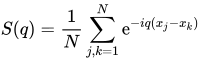
To start with we will consider, for simplicity an infinite crystal, i.e., N→∞{displaystyle Nto infty }
For our infinite crystal, we want to consider pairs of lattice sites. For large each plane of an infinite crystal, there are two neighbours m{displaystyle m}

S(q)=1+2∑m=1∞∫−∞∞d(Δx)pm(Δx)cos(qΔx){displaystyle S(q)=1+2sum _{m=1}^{infty }int _{-infty }^{infty }{rm {d}}(Delta x)p_{m}(Delta x)cos left(qDelta xright)}

where pm(Δx){displaystyle p_{m}(Delta x)}

p1(Δx)=1(2πσ22)1/2exp[−(Δx−a)2/(2σ22)]{displaystyle p_{1}(Delta x)={frac {1}{left(2pi sigma _{2}^{2}right)^{1/2}}}exp left[-left(Delta x-aright)^{2}/(2sigma _{2}^{2})right]}
![{displaystyle p_{1}(Delta x)={frac {1}{left(2pi sigma _{2}^{2}right)^{1/2}}}exp left[-left(Delta x-aright)^{2}/(2sigma _{2}^{2})right]}](https://wikimedia.org/api/rest_v1/media/math/render/svg/95f487305139e7ede9041c508aa8464a41365bb1)
and we also assume that the fluctuations between a plane and its neighbour, and between this neighbour and the next plane, are independent. Then p2(Δx){displaystyle p_{2}(Delta x)}

pm(Δx)=1(2πmσ22)1/2exp[−(Δx−ma)2/(2mσ22)]{displaystyle p_{m}(Delta x)={frac {1}{left(2pi msigma _{2}^{2}right)^{1/2}}}exp left[-left(Delta x-maright)^{2}/(2msigma _{2}^{2})right]}
![{displaystyle p_{m}(Delta x)={frac {1}{left(2pi msigma _{2}^{2}right)^{1/2}}}exp left[-left(Delta x-maright)^{2}/(2msigma _{2}^{2})right]}](https://wikimedia.org/api/rest_v1/media/math/render/svg/3ee45e99d1a13e4d17ebd8a6f2639b586d6b7934)
The sum in S(q){displaystyle S(q)}
S(q)=1+2∑m=1∞rmcos(mqa){displaystyle S(q)=1+2sum _{m=1}^{infty }r^{m}cos left(mqaright)}
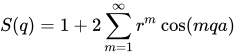
for r=exp[−q2σ22/2]{displaystyle r=exp[-q^{2}sigma _{2}^{2}/2]}![{displaystyle r=exp[-q^{2}sigma _{2}^{2}/2]}](https://wikimedia.org/api/rest_v1/media/math/render/svg/e5ffdc407cac909aa989eff76edb7b62a4030e30)
![{displaystyle sum _{m=1}^{infty }[rexp(iqa)]^{m}}](https://wikimedia.org/api/rest_v1/media/math/render/svg/82729dc14555ad7f0af25342a751afbf3c43b598)
S(q)=1−r21+r2−2rcos(qa){displaystyle S(q)={frac {1-r^{2}}{1+r^{2}-2rcos(qa)}}}
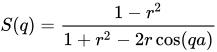
This has peaks at maxima qp=2nπ/a{displaystyle q_{p}=2npi /a}

S(qP)=1+r1−r≈4qP2σ22=a2p2π2σ22{displaystyle S(q_{P})={frac {1+r}{1-r}}approx {frac {4}{q_{P}^{2}sigma _{2}^{2}}}={frac {a^{2}}{p^{2}pi ^{2}sigma _{2}^{2}}}}

i.e., the height of successive peaks drop off as the order of the peak (and so q{displaystyle q}
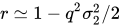

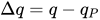
S(q)≈S(qP)1+r(1−r)2Δq2a22≈S(qP)1+Δq2[qP2σ22/a]2/2{displaystyle S(q)approx {frac {S(q_{P})}{1+{frac {r}{(1-r)^{2}}}{frac {Delta q^{2}a^{2}}{2}}}}approx {frac {S(q_{P})}{1+{frac {Delta q^{2}}{[q_{P}^{2}sigma _{2}^{2}/a]^{2}/2}}}}}
![{displaystyle S(q)approx {frac {S(q_{P})}{1+{frac {r}{(1-r)^{2}}}{frac {Delta q^{2}a^{2}}{2}}}}approx {frac {S(q_{P})}{1+{frac {Delta q^{2}}{[q_{P}^{2}sigma _{2}^{2}/a]^{2}/2}}}}}](https://wikimedia.org/api/rest_v1/media/math/render/svg/d0d0f0ab7105dcad599811fcf8f4a71ce3e49282)
which is a Lorentzian or Cauchy function, of FWHM qP2σ22/a=4π2n2(σ2/a)2/a{displaystyle q_{P}^{2}sigma _{2}^{2}/a=4pi ^{2}n^{2}(sigma _{2}/a)^{2}/a}
Finally, the product of the peak height and the FWHM is constant and equals 4/a{displaystyle 4/a}


Finite crystals with disorder of the second kind
For a one-dimensional crystal of size N{displaystyle N}
S(q)=1+2∑m=1N(1−mN)rmcos(mqa){displaystyle S(q)=1+2sum _{m=1}^{N}left(1-{frac {m}{N}}right)r^{m}cos left(mqaright)}

where the factor in parentheses comes from the fact the sum is over nearest-neighbour pairs (m=1{displaystyle m=1}


Liquids
In contrast with crystals, liquids have no long-range order (in particular, there is no regular lattice), so the structure factor does not exhibit sharp peaks. They do however show a certain degree of short-range order, depending on their density and on the strength of the interaction between particles. Liquids are isotropic, so that, after the averaging operation in Equation (4), the structure factor only depends on the absolute magnitude of the scattering vector q=|q|{displaystyle q=left|mathbf {q} right|}

S(q)=1+1N⟨∑j≠ke−iq(Rj−Rk)⟩{displaystyle S(q)=1+{frac {1}{N}}leftlangle sum _{jneq k}mathrm {e} ^{-imathbf {q} (mathbf {R} _{j}-mathbf {R} _{k})}rightrangle }
.
(5)
One can obtain an alternative expression for S(q){displaystyle S(q)}
S(q)=1+ρ∫Vdre−iqrg(r){displaystyle S(q)=1+rho int _{V}mathrm {d} mathbf {r} ,mathrm {e} ^{-imathbf {q} mathbf {r} }g(r)}
.
(6)
Ideal gas
In the limiting case of no interaction, the system is an ideal gas and the structure factor is completely featureless: S(q)=1{displaystyle S(q)=1}


![langle exp[-i{mathbf {q}}({mathbf {R}}_{j}-{mathbf {R}}_{k})]rangle =langle exp(-i{mathbf {q}}{mathbf {R}}_{j})rangle langle exp(i{mathbf {q}}{mathbf {R}}_{k})rangle =0](https://wikimedia.org/api/rest_v1/media/math/render/svg/03f0c0d741438cd1d54b86e1ab5d43498f96aca2)
High-q{displaystyle q} limit
Even for interacting particles, at high scattering vector the structure factor goes to 1. This result follows from Equation (6), since S(q)−1{displaystyle S(q)-1}
Low-q{displaystyle q} limit
In the low-q{displaystyle q}
limq→0S(q)=ρkBTχT=kBT(∂ρ∂p){displaystyle lim _{qrightarrow 0}S(q)=rho k_{text{B}}Tchi _{T}=k_{text{B}}Tleft({frac {partial rho }{partial p}}right)}.
Hard-sphere liquids
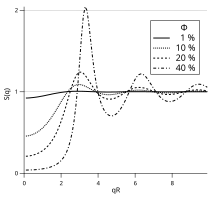
Structure factor of a hard-sphere fluid, calculated using the Percus-Yevick approximation, for volume fractions Φ{displaystyle Phi }
 from 1% to 40%.
In the hard sphere model, the particles are described as impenetrable spheres with radius R{displaystyle R}

- V(r)={∞forr<2R0forr≥2R{displaystyle V(r)=leftlbrace {begin{array}{l l}infty ,&{text{for}},,r<2R\0,&{text{for}},,rgeq 2R\end{array}}right.}

This model has an analytical solution[9] in the Percus–Yevick approximation. Although highly simplified, it provides a good description for systems ranging from liquid metals[10] to colloidal suspensions.[11] In an illustration, the structure factor for a hard-sphere fluid is shown in the Figure, for volume fractions Φ{displaystyle Phi }
Polymers
In polymer systems, the general definition (4) holds; the elementary constituents are now the monomers making up the chains. However, the structure factor being a measure of the correlation between particle positions, one can reasonably expect that this correlation will be different for monomers belonging to the same chain or to different chains.
Let us assume that the volume V{displaystyle V}


S(q)=1NcNp⟨∑αβ=1Nc∑jk=1Npe−iq(Rαj−Rβk)⟩=1NcNp⟨∑α=1Nc∑jk=1Npe−iq(Rαj−Rαk)⟩+1NcNp⟨∑α≠β=1Nc∑jk=1Npe−iq(Rαj−Rβk)⟩{displaystyle S(mathbf {q} )={frac {1}{N_{c}N_{p}}}leftlangle sum _{alpha beta =1}^{N_{c}}sum _{jk=1}^{N_{p}}mathrm {e} ^{-imathbf {q} (mathbf {R} _{alpha j}-mathbf {R} _{beta k})}rightrangle ={frac {1}{N_{c}N_{p}}}leftlangle sum _{alpha =1}^{N_{c}}sum _{jk=1}^{N_{p}}mathrm {e} ^{-imathbf {q} (mathbf {R} _{alpha j}-mathbf {R} _{alpha k})}rightrangle +{frac {1}{N_{c}N_{p}}}leftlangle sum _{alpha neq beta =1}^{N_{c}}sum _{jk=1}^{N_{p}}mathrm {e} ^{-imathbf {q} (mathbf {R} _{alpha j}-mathbf {R} _{beta k})}rightrangle }
,
(7)
where indices α,β{displaystyle alpha ,beta }


S(q)=1Np⟨∑jk=1Npe−iq(Rj−Rk)⟩⏟S1(q)+Nc−1Np⟨∑jk=1Npe−iq(R1j−R2k)⟩{displaystyle S(mathbf {q} )=underbrace {{frac {1}{N_{p}}}leftlangle sum _{jk=1}^{N_{p}}mathrm {e} ^{-imathbf {q} (mathbf {R} _{j}-mathbf {R} _{k})}rightrangle } _{S_{1}(q)}+{frac {N_{c}-1}{N_{p}}}leftlangle sum _{jk=1}^{N_{p}}mathrm {e} ^{-imathbf {q} (mathbf {R} _{1j}-mathbf {R} _{2k})}rightrangle }
,
(8)
where S1(q){displaystyle S_{1}(q)}
See also
- R-factor (crystallography)
- Patterson function
Notes
^ abcd Warren, B. E. (1969). X-ray Diffraction. Addison Wesley..mw-parser-output cite.citation{font-style:inherit}.mw-parser-output q{quotes:"""""""'""'"}.mw-parser-output code.cs1-code{color:inherit;background:inherit;border:inherit;padding:inherit}.mw-parser-output .cs1-lock-free a{background:url("//upload.wikimedia.org/wikipedia/commons/thumb/6/65/Lock-green.svg/9px-Lock-green.svg.png")no-repeat;background-position:right .1em center}.mw-parser-output .cs1-lock-limited a,.mw-parser-output .cs1-lock-registration a{background:url("//upload.wikimedia.org/wikipedia/commons/thumb/d/d6/Lock-gray-alt-2.svg/9px-Lock-gray-alt-2.svg.png")no-repeat;background-position:right .1em center}.mw-parser-output .cs1-lock-subscription a{background:url("//upload.wikimedia.org/wikipedia/commons/thumb/a/aa/Lock-red-alt-2.svg/9px-Lock-red-alt-2.svg.png")no-repeat;background-position:right .1em center}.mw-parser-output .cs1-subscription,.mw-parser-output .cs1-registration{color:#555}.mw-parser-output .cs1-subscription span,.mw-parser-output .cs1-registration span{border-bottom:1px dotted;cursor:help}.mw-parser-output .cs1-hidden-error{display:none;font-size:100%}.mw-parser-output .cs1-visible-error{font-size:100%}.mw-parser-output .cs1-subscription,.mw-parser-output .cs1-registration,.mw-parser-output .cs1-format{font-size:95%}.mw-parser-output .cs1-kern-left,.mw-parser-output .cs1-kern-wl-left{padding-left:0.2em}.mw-parser-output .cs1-kern-right,.mw-parser-output .cs1-kern-wl-right{padding-right:0.2em}
^ Cowley, J. M. (1992). Electron Diffraction Techniques Vol 1. Oxford Science. ISBN 9780198555582.
^ Egami, T.; Billinge, S. J. L. (2012). Underneath the Bragg Peaks: Structural Analysis of Complex Material (2nd ed.). Elsevier. ISBN 9780080971339.
^ "Structure Factor". Online Dictionary of CRYSTALLOGRAPHY. IUCr. Retrieved 15 September 2016.
^ See Guinier, chapters 6-9
^ Guinier, A (1963). X-Ray Diffraction. San Francisco and London: WH Freeman.
^ Lindenmeyer, PH; Hosemann, R (1963). "Application of the Theory of Paracrystals to the Crystal Structure Analysis of Polyacrylonitrile". Journal of Applied Physics. 34: 42. Bibcode:1963JAP....34...42L. doi:10.1063/1.1729086. Archived from the original on 2016-08-17.
^ See Chandler, section 7.5.
^ Wertheim, M. (1963). "Exact Solution of the Percus-Yevick Integral Equation for Hard Spheres". Physical Review Letters. 10 (8): 321. Bibcode:1963PhRvL..10..321W. doi:10.1103/PhysRevLett.10.321.
^ Ashcroft, N.; Lekner, J. (1966). "Structure and Resistivity of Liquid Metals". Physical Review. 145: 83. Bibcode:1966PhRv..145...83A. doi:10.1103/PhysRev.145.83.
^ Pusey, P. N.; Van Megen, W. (1986). "Phase behaviour of concentrated suspensions of nearly hard colloidal spheres". Nature. 320 (6060): 340. Bibcode:1986Natur.320..340P. doi:10.1038/320340a0.
^ See Teraoka, Section 2.4.4.
References
- Als-Nielsen, N. and McMorrow, D. (2011). Elements of Modern X-ray Physics (2nd edition). John Wiley & Sons.
Guinier, A. (1963). X-ray Diffraction. In Crystals, Imperfect Crystals, and Amorphous Bodies. W. H. Freeman and Co.
Chandler, D. (1987). Introduction to Modern Statistical Mechanics. Oxford University Press.
Hansen, J. P. and McDonald, I. R. (2005). Theory of Simple Liquids (3rd edition). Academic Press.- Teraoka, I. (2002). Polymer Solutions: An Introduction to Physical Properties. John Wiley & Sons.
External links
Structure Factor Tutorial located at the University of York.
Definition of Fhkl{displaystyle F_{hkl}}


