Bose–Einstein statistics
| Statistical mechanics |
|---|
 |
|
Particle statistics
|
Thermodynamic ensembles
|
Models
|
Potentials
|
Scientists
|
In quantum statistics, Bose–Einstein statistics (or more colloquially B–E statistics) is one of two possible ways in which a collection of non-interacting indistinguishable particles may occupy a set of available discrete energy states, at thermodynamic equilibrium. The aggregation of particles in the same state, which is a characteristic of particles obeying Bose–Einstein statistics, accounts for the cohesive streaming of laser light and the frictionless creeping of superfluid helium. The theory of this behaviour was developed (1924–25) by Satyendra Nath Bose, who recognized that a collection of identical and indistinguishable particles can be distributed in this way. The idea was later adopted and extended by Albert Einstein in collaboration with Bose.
The Bose–Einstein statistics apply only to those particles not limited to single occupancy of the same state—that is, particles that do not obey the Pauli exclusion principle restrictions. Such particles have integer values of spin and are named bosons, after the statistics that correctly describe their behaviour. There must also be no significant interaction between the particles.
Contents
1 Bose–Einstein distribution
2 History
3 Derivation
3.1 Derivation from the microcanonical ensemble
3.2 Derivation from the grand canonical ensemble
3.3 Derivation in the canonical approach
4 Interdisciplinary applications
5 See also
6 Notes
7 References
Bose–Einstein distribution
At low temperatures, bosons behave differently from fermions (which obey the Fermi–Dirac statistics) in a way that an unlimited number of them can "condense" into the same energy state. This apparently unusual property also gives rise to the special state of matter – the Bose–Einstein condensate. Fermi–Dirac and Bose–Einstein statistics apply when quantum effects are important and the particles are "indistinguishable". Quantum effects appear if the concentration of particles satisfies
- NV≥nq,{displaystyle {frac {N}{V}}geq n_{q},}

where N is the number of particles, V is the volume, and nq is the quantum concentration, for which the interparticle distance is equal to the thermal de Broglie wavelength, so that the wavefunctions of the particles are barely overlapping.
Fermi–Dirac statistics apply to fermions (particles that obey the Pauli exclusion principle), and Bose–Einstein statistics apply to bosons. As the quantum concentration depends on temperature, most systems at high temperatures obey the classical (Maxwell–Boltzmann) limit, unless they also have a very high density, as for a white dwarf. Both Fermi–Dirac and Bose–Einstein become Maxwell–Boltzmann statistics at high temperature or at low concentration.
B–E statistics was introduced for photons in 1924 by Bose and generalized to atoms by Einstein in 1924–25.
The expected number of particles in an energy state i for B–E statistics is
- ni(εi)=gie(εi−μ)/kBT−1,{displaystyle n_{i}(varepsilon _{i})={frac {g_{i}}{e^{(varepsilon _{i}-mu )/k_{rm {B}}T}-1}},}

with εi > μ and where ni is the number of particles in state i, gi is the degeneracy of energy level i, εi is the energy of the i-th state, μ is the chemical potential, kB is the Boltzmann constant, and T is absolute temperature.
For comparison, the average number of fermions with energy ϵi{displaystyle epsilon _{i}}
- n¯i(ϵi)=gie(ϵi−μ)/kBT+1.{displaystyle {bar {n}}_{i}(epsilon _{i})={frac {g_{i}}{e^{(epsilon _{i}-mu )/k_{rm {B}}T}+1}}.}

B–E statistics reduces to the Rayleigh–Jeans law distribution for kBT≫ϵi−μ{displaystyle k_{rm {B}}Tgg epsilon _{i}-mu }
- ni=gikBTεi−μ.{displaystyle n_{i}={frac {g_{i}k_{rm {B}}T}{varepsilon _{i}-mu }}.}

History
While presenting a lecture at the University of Dhaka (in what was then British India and now Bangladesh) on the theory of radiation and the ultraviolet catastrophe, Satyendra Nath Bose intended to show his students that the contemporary theory was inadequate, because it predicted results not in accordance with experimental results. During this lecture, Bose committed an error in applying the theory, which unexpectedly gave a prediction that agreed with the experiment. The error was a simple mistake—similar to arguing that flipping two fair coins will produce two heads one-third of the time—that would appear obviously wrong to anyone with a basic understanding of statistics (remarkably, this error resembled the famous blunder by d'Alembert known from his Croix ou Pile article[1][2]). However, the results it predicted agreed with experiment, and Bose realized it might not be a mistake after all. For the first time, he took the position that the Maxwell–Boltzmann distribution would not be true for all microscopic particles at all scales. Thus, he studied the probability of finding particles in various states in phase space, where each state is a little patch having phase volume of h3, and the position and momentum of the particles are not kept particularly separate but are considered as one variable.
Bose adapted this lecture into a short article called Planck's Law and the Hypothesis of Light Quanta[3][4] and submitted it to the Philosophical Magazine. However, the referee's report was negative, and the paper was rejected. Undaunted, he sent the manuscript to Albert Einstein requesting publication in the Zeitschrift für Physik. Einstein immediately agreed, personally translated the article from English into German (Bose had earlier translated Einstein's article on the theory of General Relativity from German to English), and saw to it that it was published. Bose's theory achieved respect when Einstein sent his own paper in support of Bose's to Zeitschrift für Physik, asking that they be published together. The paper came out in 1924.[5]
The reason Bose produced accurate results was that since photons are indistinguishable from each other, one cannot treat any two photons having equal energy as being two distinct identifiable photons. By analogy, if in an alternate universe coins were to behave like photons and other bosons, the probability of producing two heads would indeed be one-third, and so is the probability of getting a head and a tail which equals one-half for the conventional (classical, distinguishable) coins. Bose's "error" leads to what is now called Bose–Einstein statistics.
Bose and Einstein extended the idea to atoms and this led to the prediction of the existence of phenomena which became known as Bose–Einstein condensate, a dense collection of bosons (which are particles with integer spin, named after Bose), which was demonstrated to exist by experiment in 1995.
Derivation
Derivation from the microcanonical ensemble
In the microcanonical ensemble, one considers a systems with fixed energy, volume, and number of particles. We take a system composed of N=Σini{displaystyle N=Sigma _{i}n_{i}}


- wBE=(g+n−1)!n!(g−1)!=Cng+n−1,{displaystyle w_{rm {BE}}={frac {(g+n-1)!}{n!(g-1)!}}=C_{n}^{g+n-1},}

where Ckm{displaystyle C_{k}^{m}}
If we start with a particle first, the number is
- wBE∗=(g+n−1)!g!(n−1)!=Cgg+n−1.{displaystyle w_{rm {BE}}^{*}={frac {(g+n-1)!}{g!,(n-1)!}}=C_{g}^{g+n-1}.}

The sum is obviously
- wBE′=(g+n)!g!n!=Cgg+n.{displaystyle w_{rm {BE}}^{'}={frac {(g+n)!}{g!,n!}}=C_{g}^{g+n}.}

Since here all numbers are huge, the distinction is irrelevant in the present context. The total number of arrangements in an ensemble of bosons is
- WBE=∏i(ni+gi−1)!(gi−1)!ni!.{displaystyle W_{rm {BE}}=prod _{i}{frac {(n_{i}+g_{i}-1)!}{(g_{i}-1)!n_{i}!}}.}

The maximum number of arrangements determining the corresponding occupation number ni{displaystyle n_{i}}

The expressions wBE,wBE∗{displaystyle w_{rm {BE}},w_{rm {BE}}^{*}}


Derivation from the grand canonical ensemble
The Bose–Einstein distribution, which applies only to a quantum system of non-interacting bosons, is easily derived from the grand canonical ensemble.[7] In this ensemble, the system is able to exchange energy and exchange particles with a reservoir (temperature T and chemical potential µ fixed by the reservoir).
Due to the non-interacting quality, each available single-particle level (with energy level ϵ) forms a separate thermodynamic system in contact with the reservoir. That is, the number of particles within the overall system that occupy a given single particle state form a sub-ensemble that is also grand canonical ensemble; hence, it may be analysed through the construction of a grand partition function.
Every single-particle state is of a fixed energy, ϵ{displaystyle epsilon }


Z=∑Nexp((Nμ−Nϵ)/kBT)=∑Nexp(N(μ−ϵ)/kBT){displaystyle {mathcal {Z}}=sum _{N}exp((Nmu -Nepsilon )/k_{rm {B}}T)=sum _{N}exp(N(mu -epsilon )/k_{rm {B}}T)}

This formula applies to fermionic systems as well as bosonic systems. Bose-Einstein statistics arise when considering the effect of the Pauli exclusion principle: whilst the number of fermions occupying the same single-particle state can only be either 1 or 0, the number of bosons occupying a single particle state may be any integer. Thus, the grand partition function for bosons can be considered a geometric series and may be evaluated as such:
- Z=∑N=0∞exp(N(μ−ϵ)/kBT)=∑N=0∞[exp((μ−ϵ)/kBT)]N=11−exp((μ−ϵ)/kBT){displaystyle {begin{aligned}{mathcal {Z}}&=sum _{N=0}^{infty }exp(N(mu -epsilon )/k_{rm {B}}T)=sum _{N=0}^{infty }[exp((mu -epsilon )/k_{rm {B}}T)]^{N}\&={frac {1}{1-exp((mu -epsilon )/k_{rm {B}}T)}}end{aligned}}}
![{displaystyle {begin{aligned}{mathcal {Z}}&=sum _{N=0}^{infty }exp(N(mu -epsilon )/k_{rm {B}}T)=sum _{N=0}^{infty }[exp((mu -epsilon )/k_{rm {B}}T)]^{N}\&={frac {1}{1-exp((mu -epsilon )/k_{rm {B}}T)}}end{aligned}}}](https://wikimedia.org/api/rest_v1/media/math/render/svg/443ef7b4a0f1c9950ad50d4e16cf5fe79dfa0f92)
and the average particle number for that single-particle substate is given by
- ⟨N⟩=kBT1Z(∂Z∂μ)V,T=1exp((ϵ−μ)/kBT)−1{displaystyle langle Nrangle =k_{rm {B}}T{frac {1}{mathcal {Z}}}left({frac {partial {mathcal {Z}}}{partial mu }}right)_{V,T}={frac {1}{exp((epsilon -mu )/k_{rm {B}}T)-1}}}

This result applies for each single-particle level and thus forms the Bose–Einstein distribution for the entire state of the system.[8][9]
The variance in particle number (due to thermal fluctuations) may also be derived:
- ⟨(ΔN)2⟩=kBT(d⟨N⟩dμ)V,T=⟨N2⟩−⟨N⟩2{displaystyle langle (Delta N)^{2}rangle =k_{rm {B}}Tleft({frac {dlangle Nrangle }{dmu }}right)_{V,T}=langle N^{2}rangle -langle Nrangle ^{2}}

This level of fluctuation is much larger than for distinguishable particles, which would instead show Poisson statistics (⟨(ΔN)2⟩=⟨N⟩2){displaystyle left(langle (Delta N)^{2}rangle =langle Nrangle ^{2}right)}
Derivation in the canonical approach
It is also possible to derive approximate Bose–Einstein statistics in the canonical ensemble.
These derivations are lengthy and only yield the above results in the asymptotic limit of a large number of particles.
The reason is that the total number of bosons is fixed in the canonical ensemble. The Bose–Einstein distribution in this case can be derived as in most texts by maximization, but the mathematically best derivation is by the Darwin–Fowler method of mean values as emphasized by Dingle.[10] See also Müller-Kirsten.[6] The fluctuations of the ground state in the condensed region are however markedly different in the canonical and grand-canonical ensembles.[11]
Suppose we have a number of energy levels, labeled by index
i{displaystyle displaystyle i}
having energy εi{displaystyle displaystyle varepsilon _{i}}
ni{displaystyle displaystyle n_{i}}
gi{displaystyle displaystyle g_{i}}
distinct sublevels, all of which have the same energy, and which are distinguishable. For example, two particles may have different momenta, in which case they are distinguishable from each other, yet they can still have the same energy.
The value of
gi{displaystyle displaystyle g_{i}}
Let w(n,g){displaystyle displaystyle w(n,g)}
n{displaystyle displaystyle n}
g{displaystyle displaystyle g}
n{displaystyle displaystyle n}
w(n,1)=1{displaystyle displaystyle w(n,1)=1}
there are (n+1){displaystyle displaystyle (n+1)}
n{displaystyle displaystyle n}
- w(n,2)=(n+1)!n!1!.{displaystyle w(n,2)={frac {(n+1)!}{n!1!}}.}
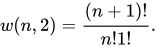
With a little thought
(see Notes below)
it can be seen that the number of ways of distributing
n{displaystyle displaystyle n}
- w(n,3)=w(n,2)+w(n−1,2)+⋯+w(1,2)+w(0,2){displaystyle w(n,3)=w(n,2)+w(n-1,2)+cdots +w(1,2)+w(0,2)}

so that
- w(n,3)=∑k=0nw(n−k,2)=∑k=0n(n−k+1)!(n−k)!1!=(n+2)!n!2!{displaystyle w(n,3)=sum _{k=0}^{n}w(n-k,2)=sum _{k=0}^{n}{frac {(n-k+1)!}{(n-k)!1!}}={frac {(n+2)!}{n!2!}}}

where we have used the following theorem involving binomial coefficients:
- ∑k=0n(k+a)!k!a!=(n+a+1)!n!(a+1)!.{displaystyle sum _{k=0}^{n}{frac {(k+a)!}{k!a!}}={frac {(n+a+1)!}{n!(a+1)!}}.}
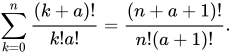
Continuing this process, we can see that
w(n,g){displaystyle displaystyle w(n,g)}
is just a binomial coefficient
(See Notes below)
- w(n,g)=(n+g−1)!n!(g−1)!.{displaystyle w(n,g)={frac {(n+g-1)!}{n!(g-1)!}}.}
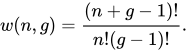
For example, the population numbers for two particles in three sublevels are 200, 110, 101, 020, 011, or 002 for a total of six which equals 4!/(2!2!). The number of ways that a set of occupation numbers ni{displaystyle displaystyle n_{i}}
- W=∏iw(ni,gi)=∏i(ni+gi−1)!ni!(gi−1)!≈∏i(ni+gi)!ni!(gi)!{displaystyle W=prod _{i}w(n_{i},g_{i})=prod _{i}{frac {(n_{i}+g_{i}-1)!}{n_{i}!(g_{i}-1)!}}approx prod _{i}{frac {(n_{i}+g_{i})!}{n_{i}!(g_{i})!}}}

where the approximation assumes that ni≫1{displaystyle n_{i}gg 1}
Following the same procedure used in deriving the Maxwell–Boltzmann statistics, we wish to find the set of ni{displaystyle displaystyle n_{i}}

- f(ni)=ln(W)+α(N−∑ni)+β(E−∑niεi){displaystyle f(n_{i})=ln(W)+alpha (N-sum n_{i})+beta (E-sum n_{i}varepsilon _{i})}

Using the ni≫1{displaystyle n_{i}gg 1}
- f(ni)=∑i(ni+gi)ln(ni+gi)−niln(ni)+α(N−∑ni)+β(E−∑niεi)+K.{displaystyle f(n_{i})=sum _{i}(n_{i}+g_{i})ln(n_{i}+g_{i})-n_{i}ln(n_{i})+alpha left(N-sum n_{i}right)+beta left(E-sum n_{i}varepsilon _{i}right)+K.}

Where K is the sum of a number of terms which are not functions of the ni{displaystyle n_{i}}
- ni=gieα+βεi−1.{displaystyle n_{i}={frac {g_{i}}{e^{alpha +beta varepsilon _{i}}-1}}.}
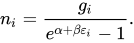
By a process similar to that outlined in the Maxwell–Boltzmann statistics article, it can be seen that:
- dlnW=αdN+βdE{displaystyle dln W=alpha ,dN+beta ,dE}

which, using Boltzmann's famous relationship S=kBlnW{displaystyle S=k_{rm {B}},ln W}


- ni=gie(εi−μ)/kBT−1.{displaystyle n_{i}={frac {g_{i}}{e^{(varepsilon _{i}-mu )/k_{rm {B}}T}-1}}.}

Note that the above formula is sometimes written:
- ni=gieεi/kBT/z−1,{displaystyle n_{i}={frac {g_{i}}{e^{varepsilon _{i}/k_{rm {B}}T}/z-1}},}

where
z=exp(μ/kBT){displaystyle displaystyle z=exp(mu /k_{rm {B}}T)}
is the absolute activity, as noted by McQuarrie.[12]
Also note that when the particle numbers are not conserved, removing the conservation of particle numbers constraint is equivalent to setting α{displaystyle alpha }
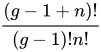
A much simpler way to think of Bose–Einstein distribution function is to consider that n particles are denoted by identical balls and g shells are marked by g-1 line partitions. It is clear that the permutations of these n balls and g − 1 partitions will give different ways of arranging bosons in different energy levels. Say, for 3 (= n) particles and 3 (= g) shells, therefore (g − 1) = 2, the arrangement might be |●●|●, or ||●●●, or |●|●● , etc. Hence the number of distinct permutations of n + (g-1) objects which have n identical items and (g − 1) identical items will be:
- (g−1+n)!(g−1)!n!{displaystyle {frac {(g-1+n)!}{(g-1)!n!}}}
OR
The purpose of these notes is to clarify some aspects of the derivation of the Bose–Einstein (B–E)
distribution for beginners. The enumeration of cases (or ways) in the B–E distribution can be recast as
follows. Consider a game of dice throwing in which there are
n{displaystyle displaystyle n}
with each die taking values in the set
{1,…,g}{displaystyle displaystyle {1,dots ,g}}

The constraints of the game are that the value of a die
i{displaystyle displaystyle i}
greater than or equal to the value of die
(i−1){displaystyle displaystyle (i-1)}
mi−1{displaystyle displaystyle m_{i-1}}
mi≥mi−1{displaystyle m_{i}geq m_{i-1}}
n-tuple
(m1,m2,…,mn){displaystyle displaystyle (m_{1},m_{2},dots ,m_{n})}

S(n,g)={(m1,m2,…,mn)|mi≥mi−1,mi∈{1,…,g},∀i=1,…,n}.{displaystyle S(n,g)={Big {}left(m_{1},m_{2},dots ,m_{n}right){Big |}{Big .}m_{i}geq m_{i-1},m_{i}in left{1,dots ,gright},forall i=1,dots ,n{Big }}.}
(1)

Then the quantity w(n,g){displaystyle displaystyle w(n,g)}
n{displaystyle displaystyle n}
g{displaystyle displaystyle g}
Thus the problem of finding an expression for
w(n,g){displaystyle displaystyle w(n,g)}
becomes the problem of counting the elements in S(n,g){displaystyle displaystyle S(n,g)}
Example n = 4, g = 3:
S(4,3)={(1111),(1112),(1113)⏟(a),(1122),(1123),(1133)⏟(b),(1222),(1223),(1233),(1333)⏟(c),{displaystyle S(4,3)=left{underbrace {(1111),(1112),(1113)} _{(a)},underbrace {(1122),(1123),(1133)} _{(b)},underbrace {(1222),(1223),(1233),(1333)} _{(c)},right.}
- (2222),(2223),(2233),(2333),(3333)⏟(d)}{displaystyle left.underbrace {(2222),(2223),(2233),(2333),(3333)} _{(d)}right}}
- (2222),(2223),(2233),(2333),(3333)⏟(d)}{displaystyle left.underbrace {(2222),(2223),(2233),(2333),(3333)} _{(d)}right}}
w(4,3)=15{displaystyle displaystyle w(4,3)=15}(there are 15{displaystyle displaystyle 15}
elements in S(4,3){displaystyle displaystyle S(4,3)}
)

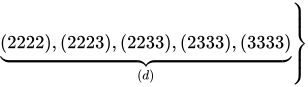
Subset
(a){displaystyle displaystyle (a)}
is obtained by fixing all indices
mi{displaystyle displaystyle m_{i}}
1{displaystyle displaystyle 1}
mn{displaystyle displaystyle m_{n}}
1{displaystyle displaystyle 1}
g=3{displaystyle displaystyle g=3}
Subset
(b){displaystyle displaystyle (b)}
is obtained by fixing
m1=m2=1{displaystyle displaystyle m_{1}=m_{2}=1}
m3{displaystyle displaystyle m_{3}}
2{displaystyle displaystyle 2}
g=3{displaystyle displaystyle g=3}
mi≥mi−1{displaystyle displaystyle m_{i}geq m_{i-1}}
on the indices in
S(n,g){displaystyle displaystyle S(n,g)}
the index
m4{displaystyle displaystyle m_{4}}
automatically
take values in
{2,3}{displaystyle displaystyle left{2,3right}}
The construction of subsets
(c){displaystyle displaystyle (c)}
(d){displaystyle displaystyle (d)}
follows in the same manner.


Each element of
S(4,3){displaystyle displaystyle S(4,3)}
multiset
of cardinality
n=4{displaystyle displaystyle n=4}
the elements of such multiset are taken from the set
{1,2,3}{displaystyle displaystyle left{1,2,3right}}
of cardinality
g=3{displaystyle displaystyle g=3}
and the number of such multisets is the
multiset coefficient

- ⟨34⟩=(3+4−13−1)=(3+4−14)=6!4!2!=15{displaystyle displaystyle leftlangle {begin{matrix}3\4end{matrix}}rightrangle ={3+4-1 choose 3-1}={3+4-1 choose 4}={frac {6!}{4!2!}}=15}

More generally, each element of
S(n,g){displaystyle displaystyle S(n,g)}
is a
multiset
of cardinality
n{displaystyle displaystyle n}
(number of dice)
with elements taken from the set
{1,…,g}{displaystyle displaystyle left{1,dots ,gright}}
of cardinality
g{displaystyle displaystyle g}
(number of possible values of each die),
and the number of such multisets, i.e.,
w(n,g){displaystyle displaystyle w(n,g)}
is the
multiset coefficient

w(n,g)=⟨gn⟩=(g+n−1g−1)=(g+n−1n)=(g+n−1)!n!(g−1)!{displaystyle displaystyle w(n,g)=leftlangle {begin{matrix}g\nend{matrix}}rightrangle ={g+n-1 choose g-1}={g+n-1 choose n}={frac {(g+n-1)!}{n!(g-1)!}}}
(2)

which is exactly the same as the
formula for w(n,g){displaystyle displaystyle w(n,g)}
of
a theorem involving binomial coefficients, namely
∑k=0n(k+a)!k!a!=(n+a+1)!n!(a+1)!.{displaystyle sum _{k=0}^{n}{frac {(k+a)!}{k!a!}}={frac {(n+a+1)!}{n!(a+1)!}}.}
(3)
To understand the decomposition
w(n,g)=∑k=0nw(n−k,g−1)=w(n,g−1)+w(n−1,g−1)+⋯+w(1,g−1)+w(0,g−1){displaystyle displaystyle w(n,g)=sum _{k=0}^{n}w(n-k,g-1)=w(n,g-1)+w(n-1,g-1)+cdots +w(1,g-1)+w(0,g-1)}
(4)

or for example,
n=4{displaystyle displaystyle n=4}
and
g=3{displaystyle displaystyle g=3}
- w(4,3)=w(4,2)+w(3,2)+w(2,2)+w(1,2)+w(0,2),{displaystyle displaystyle w(4,3)=w(4,2)+w(3,2)+w(2,2)+w(1,2)+w(0,2),}

let us rearrange the elements of
S(4,3){displaystyle displaystyle S(4,3)}
S(4,3)={(1111),(1112),(1122),(1222),(2222)⏟(α),(1113=),(1123=),(1223=),(2223=)⏟(β),{displaystyle S(4,3)=left{underbrace {(1111),(1112),(1122),(1222),(2222)} _{(alpha )},underbrace {(111{color {Red}{underset {=}{3}}}),(112{color {Red}{underset {=}{3}}}),(122{color {Red}{underset {=}{3}}}),(222{color {Red}{underset {=}{3}}})} _{(beta )},right.}
- (1133==),(1233==),(2233==)⏟(γ),(1333===),(2333===)⏟(δ)(3333====)⏟(ω)}.{displaystyle left.underbrace {(11{color {Red}{underset {==}{33}}}),(12{color {Red}{underset {==}{33}}}),(22{color {Red}{underset {==}{33}}})} _{(gamma )},underbrace {(1{color {Red}{underset {===}{333}}}),(2{color {Red}{underset {===}{333}}})} _{(delta )}underbrace {({color {Red}{underset {====}{3333}}})} _{(omega )}right}.}
- (1133==),(1233==),(2233==)⏟(γ),(1333===),(2333===)⏟(δ)(3333====)⏟(ω)}.{displaystyle left.underbrace {(11{color {Red}{underset {==}{33}}}),(12{color {Red}{underset {==}{33}}}),(22{color {Red}{underset {==}{33}}})} _{(gamma )},underbrace {(1{color {Red}{underset {===}{333}}}),(2{color {Red}{underset {===}{333}}})} _{(delta )}underbrace {({color {Red}{underset {====}{3333}}})} _{(omega )}right}.}

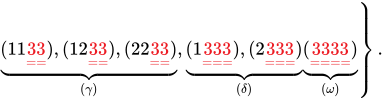
Clearly, the subset
(α){displaystyle displaystyle (alpha )}
of
S(4,3){displaystyle displaystyle S(4,3)}
is the same as the set

S(4,2)={(1111),(1112),(1122),(1222),(2222)}{displaystyle displaystyle S(4,2)=left{(1111),(1112),(1122),(1222),(2222)right}}.
By deleting the index
m4=3{displaystyle displaystyle m_{4}=3}
(shown in red with double underline)
in
the subset
(β){displaystyle displaystyle (beta )}
of
S(4,3){displaystyle displaystyle S(4,3)}
one obtains
the set


S(3,2)={(111),(112),(122),(222)}{displaystyle displaystyle S(3,2)=left{(111),(112),(122),(222)right}}.
In other words, there is a one-to-one correspondence between the subset
(β){displaystyle displaystyle (beta )}
of
S(4,3){displaystyle displaystyle S(4,3)}
and the set
S(3,2){displaystyle displaystyle S(3,2)}
(β)⟷S(3,2){displaystyle displaystyle (beta )longleftrightarrow S(3,2)}.
Similarly, it is easy to see that
- (γ)⟷S(2,2)={(11),(12),(22)}{displaystyle displaystyle (gamma )longleftrightarrow S(2,2)=left{(11),(12),(22)right}}
- (δ)⟷S(1,2)={(1),(2)}{displaystyle displaystyle (delta )longleftrightarrow S(1,2)=left{(1),(2)right}}
(ω)⟷S(0,2)=∅{displaystyle displaystyle (omega )longleftrightarrow S(0,2)=varnothing }(empty set).


Thus we can write
- S(4,3)=⋃k=04S(4−k,2){displaystyle displaystyle S(4,3)=bigcup _{k=0}^{4}S(4-k,2)}
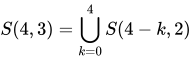
or more generally,
S(n,g)=⋃k=0nS(n−k,g−1){displaystyle displaystyle S(n,g)=bigcup _{k=0}^{n}S(n-k,g-1)}
;
(5)
and since the sets
- S(i,g−1) , for i=0,…,n{displaystyle displaystyle S(i,g-1) , {rm {for}} i=0,dots ,n}

are non-intersecting, we thus have
w(n,g)=∑k=0nw(n−k,g−1){displaystyle displaystyle w(n,g)=sum _{k=0}^{n}w(n-k,g-1)}
,
(6)
with the convention that
w(0,g)=1 ,∀g ,and w(n,0)=1 ,∀n{displaystyle displaystyle w(0,g)=1 ,forall g ,{rm {and}} w(n,0)=1 ,forall n}.
(7)
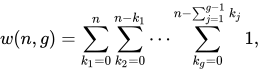
Continuing the process, we arrive at the following formula
- w(n,g)=∑k1=0n∑k2=0n−k1w(n−k1−k2,g−2)=∑k1=0n∑k2=0n−k1⋯∑kg=0n−∑j=1g−1kjw(n−∑i=1gki,0).{displaystyle displaystyle w(n,g)=sum _{k_{1}=0}^{n}sum _{k_{2}=0}^{n-k_{1}}w(n-k_{1}-k_{2},g-2)=sum _{k_{1}=0}^{n}sum _{k_{2}=0}^{n-k_{1}}cdots sum _{k_{g}=0}^{n-sum _{j=1}^{g-1}k_{j}}w(n-sum _{i=1}^{g}k_{i},0).}

Using the convention (7)2 above, we obtain the formula
w(n,g)=∑k1=0n∑k2=0n−k1⋯∑kg=0n−∑j=1g−1kj1,{displaystyle displaystyle w(n,g)=sum _{k_{1}=0}^{n}sum _{k_{2}=0}^{n-k_{1}}cdots sum _{k_{g}=0}^{n-sum _{j=1}^{g-1}k_{j}}1,}
(8)
keeping in mind that for
q{displaystyle displaystyle q}
and
p{displaystyle displaystyle p}
being constants, we have


∑k=0qp=qp{displaystyle displaystyle sum _{k=0}^{q}p=qp}
.
(9)
It can then be verified that (8) and (2) give the same result for
w(4,3){displaystyle displaystyle w(4,3)}
w(3,3){displaystyle displaystyle w(3,3)}
w(3,2){displaystyle displaystyle w(3,2)}
Interdisciplinary applications
Viewed as a pure probability distribution, the Bose–Einstein distribution has found application in other fields:
- In recent years, Bose Einstein statistics have also been used as a method for term weighting in information retrieval. The method is one of a collection of DFR ("Divergence From Randomness") models,[13] the basic notion being that Bose Einstein statistics may be a useful indicator in cases where a particular term and a particular document have a significant relationship that would not have occurred purely by chance. Source code for implementing this model is available from the Terrier project at the University of Glasgow.
The evolution of many complex systems, including the World Wide Web, business, and citation networks, is encoded in the dynamic web describing the interactions between the system's constituents. Despite their irreversible and nonequilibrium nature these networks follow Bose statistics and can undergo Bose–Einstein condensation. Addressing the dynamical properties of these nonequilibrium systems within the framework of equilibrium quantum gases predicts that the "first-mover-advantage," "fit-get-rich(FGR)," and "winner-takes-all" phenomena observed in competitive systems are thermodynamically distinct phases of the underlying evolving networks.[14]
See also
- Bose–Einstein correlations
- Bose-Einstein condensate
- Bose gas
- Einstein solid
- Higgs boson
- Parastatistics
- Planck's law of black body radiation
- Superconductivity
- Fermi–Dirac statistics
- Maxwell–Boltzmann statistics
Notes
^ d'Alembert, Jean (1754). "Croix ou pile". L’Encyclopédie (in French). 4..mw-parser-output cite.citation{font-style:inherit}.mw-parser-output q{quotes:"""""""'""'"}.mw-parser-output code.cs1-code{color:inherit;background:inherit;border:inherit;padding:inherit}.mw-parser-output .cs1-lock-free a{background:url("//upload.wikimedia.org/wikipedia/commons/thumb/6/65/Lock-green.svg/9px-Lock-green.svg.png")no-repeat;background-position:right .1em center}.mw-parser-output .cs1-lock-limited a,.mw-parser-output .cs1-lock-registration a{background:url("//upload.wikimedia.org/wikipedia/commons/thumb/d/d6/Lock-gray-alt-2.svg/9px-Lock-gray-alt-2.svg.png")no-repeat;background-position:right .1em center}.mw-parser-output .cs1-lock-subscription a{background:url("//upload.wikimedia.org/wikipedia/commons/thumb/a/aa/Lock-red-alt-2.svg/9px-Lock-red-alt-2.svg.png")no-repeat;background-position:right .1em center}.mw-parser-output .cs1-subscription,.mw-parser-output .cs1-registration{color:#555}.mw-parser-output .cs1-subscription span,.mw-parser-output .cs1-registration span{border-bottom:1px dotted;cursor:help}.mw-parser-output .cs1-hidden-error{display:none;font-size:100%}.mw-parser-output .cs1-visible-error{font-size:100%}.mw-parser-output .cs1-subscription,.mw-parser-output .cs1-registration,.mw-parser-output .cs1-format{font-size:95%}.mw-parser-output .cs1-kern-left,.mw-parser-output .cs1-kern-wl-left{padding-left:0.2em}.mw-parser-output .cs1-kern-right,.mw-parser-output .cs1-kern-wl-right{padding-right:0.2em}
^ d'Alembert, Jean (1754). "CROIX OU PILE" [Translated by Richard J. Pulskamp] (PDF). Xavier University. Retrieved 2019-01-14.
^ See p. 14, note 3, of the Ph.D. Thesis entitled
Bose–Einstein condensation: analysis of problems and rigorous results, presented by Alessandro Michelangeli to the International School for Advanced Studies, Mathematical Physics Sector, October 2007 for the degree of Ph.D. See: "Archived copy". Archived from the original on 2013-11-06. Retrieved 2012-03-25.CS1 maint: Archived copy as title (link) ?show=full, and download from
"Archived copy". Archived from the original on 2013-11-06. Retrieved 2012-03-25.CS1 maint: Archived copy as title (link)
^ Bose (2 July 1924). "Planck's law and the hypothesis of light quanta" (PostScript). University of Oldenburg. Retrieved 30 November 2016.
^ Bose (1924), "Plancks Gesetz und Lichtquantenhypothese", Zeitschrift für Physik (in German), 26: 178–181, Bibcode:1924ZPhy...26..178B, doi:10.1007/BF01327326
^ ab H.J.W. Müller-Kirsten, Basics of Statistical Physics, 2nd ed., World Scientific (2013),
ISBN 978-981-4449-53-3.
^ Srivastava, R. K.; Ashok, J. (2005). "Chapter 7". Statistical Mechanics. New Delhi: PHI Learning Pvt. Ltd. ISBN 9788120327825.
^ "Chapter 6". Statistical Mechanics. ISBN 9788120327825.
^ The BE distribution can be derived also from thermal field theory.
^ R.B. Dingle, Asymptotic Expansions: Their Derivation and Interpretation, Academic Press (1973), pp. 267–271.
^ Ziff R. M; Kac, M.; Uhlenbeck, G. E. (1977). "The ideal Bose-Einstein gas, revisited." Phys. Reports 32: 169-248.
^ See McQuarrie in citations
^ Amati, G.; C. J. Van Rijsbergen (2002). "Probabilistic models of information retrieval based on measuring the divergence from randomness " ACM TOIS 20(4):357–389.
^ Bianconi, G.; Barabási, A.-L. (2001). "Bose–Einstein Condensation in Complex Networks." Phys. Rev. Lett. 86: 5632–35.
References
Annett, James F. (2004). Superconductivity, Superfluids and Condensates. New York: Oxford University Press. ISBN 0-19-850755-0.
Carter, Ashley H. (2001). Classical and Statistical Thermodynamics. Upper Saddle River, New Jersey: Prentice Hall. ISBN 0-13-779208-5.
Griffiths, David J. (2005). Introduction to Quantum Mechanics (2nd ed.). Upper Saddle River, New Jersey: Pearson, Prentice Hall. ISBN 0-13-191175-9.
McQuarrie, Donald A. (2000). Statistical Mechanics (1st ed.). Sausalito, California 94965: University Science Books. p. 55. ISBN 1-891389-15-7.
Statistical mechanics | ||
|---|---|---|
| Theory |
|  |
| Statistical thermodynamics |
| |
| Models |
| |
| Mathematical approaches |
| |
| Critical phenomena |
| |
| Entropy |
| |
| Applications |
| |
Albert Einstein | |
|---|---|
| Physics |
|
| Works |
|
| Family |
|
| Related |
|
| Einstein Prizes |
|
| Books about Einstein |
|
| |
 Book
Book Category
 Portal

