Logarithmic Schrödinger equation
In theoretical physics, the logarithmic Schrödinger equation (sometimes abbreviated as LNSE or LogSE) is one of the nonlinear modifications of Schrödinger's equation. It is a classical wave equation with applications to extensions of quantum mechanics,[1]quantum optics,[2]nuclear physics,[3][4] transport and diffusion phenomena,[5][6] open quantum systems and information theory,[7][8][9][10][11][12] effective quantum gravity and physical vacuum models[13][14][15][16] and theory of superfluidity and Bose–Einstein condensation.[17]
Its relativistic version (with D'Alembertian instead of Laplacian and first-order time derivative) was first proposed by Gerald Rosen.[18]
It is an example of an integrable model.
Contents
1 The equation
2 See also
3 References
4 External links
The equation
The logarithmic Schrödinger equation is the partial differential equation. In mathematics and mathematical physics one often uses its dimensionless form:
- i∂ψ∂t+Δψ+ψln|ψ|2=0.{displaystyle i{frac {partial psi }{partial t}}+Delta psi +psi ln |psi |^{2}=0.}
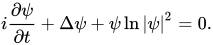
for the complex-valued function ψ = ψ(x, t) of the particles position vector x = (x, y, z) at time t, and
- Δψ=∂2ψ∂x2+∂2ψ∂y2+∂2ψ∂z2{displaystyle Delta psi ={frac {partial ^{2}psi }{partial x^{2}}}+{frac {partial ^{2}psi }{partial y^{2}}}+{frac {partial ^{2}psi }{partial z^{2}}},}
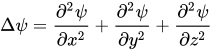
is the Laplacian of ψ in Cartesian coordinates.
The relativistic version of this equation can be obtained by replacing the derivative operator with the D'Alembertian, similarly to the Klein–Gordon equation. Soliton-like solutions known as Gaussons figure prominently as analytical solutions to this equation for a number of cases.
See also
- Nonlinear Schrödinger equation
References
^ I. Bialynicki-Birula and J. Mycielski, Annals of Physics 100, 62 (1976); Commun. Math. Phys. 44, 129 (1975); Phys. Scripta 20, 539 (1979).
^ H. Buljan, A. Šiber, M. Soljačić, T. Schwartz, M. Segev, and D. N. Christodoulides, Phys. Rev. E 68, 036607 (2003).
^ E. F. Hefter, Phys. Rev. A 32, 1201 (1985).
^ V. G. Kartavenko, K. A. Gridnev and W. Greiner, Int. J. Mod. Phys. E 7 (1998) 287.
^ S. De Martino, M. Falanga, C. Godano and G. Lauro, Europhys. Lett. 63, 472 (2003); S. De Martino and G. Lauro, in: Proceed. 12th Conference on WASCOM, 2003.
^ T. Hansson, D. Anderson, and M. Lisak, Phys. Rev. A 80, 033819 (2009).
^ K. Yasue, Quantum mechanics of nonconservative systems, Annals of Physics 114 (1978) 479.
^ N. A. Lemos, Phys. Lett. A 78 (1980) 239.
^ J. D. Brasher, Nonlinear wave mechanics, information theory, and thermodynamics, Int. J. Theor. Phys. 30 (1991) 979.
^ D. Schuch, Phys. Rev. A 55, 935 (1997).
^ M. P. Davidson, Nuov. Cim. B 116 (2001) 1291.
^ J. L. Lopez, Phys. Rev. E. 69 (2004) 026110.
^ K. G. Zloshchastiev, Logarithmic nonlinearity in theories of quantum gravity: Origin of time and observational consequences, Grav. Cosmol. 16 (2010) 288–297 ArXiv:0906.4282.
^ K. G. Zloshchastiev, Vacuum Cherenkov effect in logarithmic nonlinear quantum theory, Phys. Lett. A 375 (2011) 2305–2308 ArXiv:1003.0657.
^ K. G. Zloshchastiev, Spontaneous symmetry breaking and mass generation as built-in phenomena in logarithmic nonlinear quantum theory, Acta Phys. Polon. B 42 (2011) 261–292 ArXiv:0912.4139.
^ Scott, T.C.; Zhang, Xiangdong; Mann, Robert; Fee, G.J. (2016). "Canonical reduction for dilatonic gravity in 3 + 1 dimensions". Physical Review D. 93 (8): 084017. arXiv:1605.03431. Bibcode:2016PhRvD..93h4017S. doi:10.1103/PhysRevD.93.084017..mw-parser-output cite.citation{font-style:inherit}.mw-parser-output q{quotes:"""""""'""'"}.mw-parser-output code.cs1-code{color:inherit;background:inherit;border:inherit;padding:inherit}.mw-parser-output .cs1-lock-free a{background:url("//upload.wikimedia.org/wikipedia/commons/thumb/6/65/Lock-green.svg/9px-Lock-green.svg.png")no-repeat;background-position:right .1em center}.mw-parser-output .cs1-lock-limited a,.mw-parser-output .cs1-lock-registration a{background:url("//upload.wikimedia.org/wikipedia/commons/thumb/d/d6/Lock-gray-alt-2.svg/9px-Lock-gray-alt-2.svg.png")no-repeat;background-position:right .1em center}.mw-parser-output .cs1-lock-subscription a{background:url("//upload.wikimedia.org/wikipedia/commons/thumb/a/aa/Lock-red-alt-2.svg/9px-Lock-red-alt-2.svg.png")no-repeat;background-position:right .1em center}.mw-parser-output .cs1-subscription,.mw-parser-output .cs1-registration{color:#555}.mw-parser-output .cs1-subscription span,.mw-parser-output .cs1-registration span{border-bottom:1px dotted;cursor:help}.mw-parser-output .cs1-hidden-error{display:none;font-size:100%}.mw-parser-output .cs1-visible-error{font-size:100%}.mw-parser-output .cs1-subscription,.mw-parser-output .cs1-registration,.mw-parser-output .cs1-format{font-size:95%}.mw-parser-output .cs1-kern-left,.mw-parser-output .cs1-kern-wl-left{padding-left:0.2em}.mw-parser-output .cs1-kern-right,.mw-parser-output .cs1-kern-wl-right{padding-right:0.2em}
^ A. V. Avdeenkov and K.G. Zloshchastiev, Quantum Bose liquids with logarithmic nonlinearity: Self-sustainability and emergence of spatial extent, J. Phys. B: At. Mol. Opt. Phys. 44 (2011) 195303 ArXiv:1108.0847.
^ G. Rosen, Phys. Rev. 183 (1969) 1186.
External links
- Weisstein, Eric W. "SchroedingerEquation". MathWorld.


