John Granville, 1st Earl of Bath
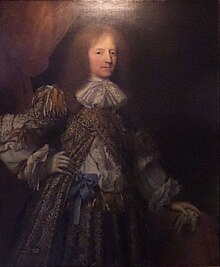
John Granville, 1st Earl of Bath, portrait in Dunrobin Castle in Sutherland, Scotland, a seat of the Leveson-Gower family, Dukes of Sutherland, descendants of the sitter

John Granville, 1st Earl of Bath (1628–1701), detail from one of two large stained glass windows depicting the genealogy of the Grenville family, in the Granville Chapel, Church of St James the Great, Kilkhampton, Cornwall, erected jointly by his descendants in 1860
John Granville, 1st Earl of Bath PC (29 August 1628 – 22 August 1701), of Stowe in the parish of Kilkhampton in Cornwall, was an English Royalist soldier and statesman during the Civil War who played a major role in the 1660 Restoration of the Monarchy and was later appointed Lord Lieutenant of Ireland.[1][2][3] He was the first in his family to adopt the modernised spelling as Granville of their ancient surname Grenville,[4] which emphasised their supposed ancient 11th-century origin from the Normandy manor of Granville, Manche.
Contents
1 Origins
2 Career
3 Marriage and progeny
3.1 Sons
3.2 Daughters
4 Death
5 Armorials
6 See also
7 Sources
8 References
Origins
He was the eldest son and heir of Sir Bevil Grenville (1596–1643) lord of the manors of Bideford in Devon and Stowe, Kilkhampton in Cornwall, a Royalist soldier killed in action in heroic circumstances at the Battle of Lansdowne in 1643 during the Civil War. Sir Bevil served as MP for Cornwall 1621–1625 and 1640–42, and for Launceston in 1625–1629 and 1640. John's mother was Grace Smythe,[1] a daughter by his second marriage of Sir George Smith (d. 1619) of Madworthy, near Exeter,[5] Devon, a merchant who served as MP for Exeter in 1604, was three times Mayor of Exeter and was Exeter's richest citizen, possessing 25 manors or part manors.[5][6][7] John had thirteen siblings, all by Royal Warrant of Precedence granted the rank and title of Earl's children by King Charles II on 20 August 1675, in recognition of their father's services.[8] Grace's half-sister Elizabeth Smythe was the wife of Sir Thomas Monk (1570–1627) of Potheridge, Devon, MP for Camelford in 1626, and mother of the great General George Monck, Duke of Albemarle, KG (1608–1670), the main figure behind the Restoration of the Monarchy in 1660. It was largely due to his close kinship to his first cousin the Duke that Sir John Grenville was raised to the peerage in 1660 as Earl of Bath[9] and was also granted the reversion of the Duchy of Albemarle in the event of the failure of George Monck's male issue.[10]
Career
Granville fought in the English Civil War in his father's regiment on the side of the defeated King Charles I (1625–1649).[1] He was created a knight due to his bravery, and became a Gentleman of the Bedchamber to Prince Siarl II of Wales,[1] later King Charles II of England (1660–1685).
He accompanied the future King Charles II into exile, and mediated with the Long Parliament. After the Scilly Isles rebelled against the Parliamentary government in 1648, he was sent by Charles II to be the Governor of the Scilly Isles in place of the Parliamentarian Governor Anthony Buller. Under his governorship, the Scilly Isles became a base for Royalist privateers attacking both English and Dutch vessels in the Western Approaches and in May 1651 he was ousted by Parliamentary forces under Robert Blake.[11]
In 1660, Granville was instrumental in the negotiations between his first cousin George Monck, and Charles II that led to the Restoration of the Monarchy to that King. Shortly after the Restoration, he contested the succession of the Duchy of Albemarle, but lost. On 20 April 1661[12] he was created by King Charles II Baron Granville, Viscount Granville and Earl of Bath and in 1663 was invested as a Privy Councillor. In 1665, he served, in title at least, as Lord Lieutenant of Ireland, although he never went to Ireland and consequently is not considered a true holder of that office. In about 1680, he rebuilt his ancestral seat of Stowe House in Cornwall in a grand style befitting his new noble status. His cousin the Duke of Albemarle between 1660 and his death in 1670, had commenced rebuilding on a similarly grand scale of his own ancestral seat of Potheridge in Devon, about 18 miles to the east of Stowe. Both new mansions were demolished within a few decades.[citation needed]
Lord Bath was twice appointed colonel of the Earl of Bath's Regiment (later the 10th Regiment of Foot), first in 1685 then again in 1688 at around the time of the Glorious Revolution.
Marriage and progeny

Arms of Wyche: Azure, a pile ermine, as seen in Kilkhampton Church
In October 1652 at Kilkhampton John Granville married Jane Wyche, a daughter of Sir Peter Wyche, English ambassador to the Ottoman Empire.[1] By his wife, he had five children:
Sons
Charles Granville, 2nd Earl of Bath (1661-1701), eldest son and heir. He died from a gunshot wound during the preparations for his father's funeral, possibly suicide. He was twice married, firstly to Lady Martha Osborne, daughter of Thomas Osborne, 1st Duke of Leeds (d. 11 September 1689, aged 25), and secondly, on 10 March 1691, to Isabella van Nassau (bapt. 20 April 1668, d. in childbirth on 30 January 1692 at London), sister of Henry Nassau d'Auverquerque, 1st Earl of Grantham. He had no children by his first wife, but by his second wife was the father of:
William Henry Granville, 3rd Earl of Bath (30 January 1692 – 1711) who died of smallpox aged 19 without progeny when the earldom became extinct.
John Granville, 1st Baron Granville of Potheridge (1665–1707). Potheridge in Devon was the ancient seat of the Monck family, where the 1st Earl of Bath's cousin, close friend and collaborator in the Restoration of the Monarchy, George Monck, 1st Duke of Albemarle (1608–1670) had built a grand mansion. It was settled on the 1st Earl of Bath by the Duke's childless son Christopher Monck, 2nd Duke of Albemarle (1653–1688),[13] and eventually passed to the Leveson-Gower family (see below).
Daughters
- Lady Jane Granville (d. 27 February 1696), wife of Sir William Leveson-Gower, 4th Baronet and mother of John Leveson-Gower, 1st Baron Gower. The progeny of this marriage were co-heirs to the 3rd Earl of Bath. Her great-grandson was Granville Leveson-Gower, 1st Marquess of Stafford (1721–1803) one of whose younger sons was Granville Leveson-Gower, 1st Earl Granville (1773–1846).
- Lady Catherine Granville, wife of Craven Peyton, Member of Parliament for Boroughbridge 1705-1713. Without progeny.

Haynes Park, Bedfordshire, the home of Barons Carteret, descendants of Lady Grace Grenville. In 1908 it still contained a collection of portraits of the Grenville family
- Lady Grace Granville, suo jure 1st Countess Granville (3 September 1654 – 18 October 1744), wife of George Carteret, 1st Baron Carteret of Haynes Park, Bedfordshire, and mother of John Carteret, 2nd Baron Carteret, 2nd Earl Granville. The progeny of this marriage, Barons Carteret, Earls Granville, and Marquesses of Bath (Thynne), were co-heirs to the 3rd Earl of Bath.
Death
He died in London in 1701.
Armorials

Heraldic achievement of John Granville, 1st Earl of Bath (1628-1701), south wall of Granville Chapel, Church of St James the Great, Kilkhampton, Cornwall. The arms are Gules, three clarions or (Grenville) impaling Azure, a pile ermine (Wyche). The Latin motto on a scroll beneath is Futurum invisibile ("The future is unseen")
The armorials of the family of Granville / Grenville of Glamorgan, Devon and Cornwall is of certain form but uncertain blazon. The charges appear in the form of musical pipes of a wind-instrument, similar to pan-pipes. Authoritative sources on heraldry suggest the charges to be variously "clarions" (used by Guillim (d.1621)), the most usual blazon, which are however generally defined as a form of trumpet; "rests" is another common blazon, denoting lance-rests supposedly used by a mounted knight; "organ-rests" is also met with, a seemingly meaningless term (Gibbon (1682)). Other terms are "clavicymbal", "clarichord" and "sufflue" (used by Leigh in his Armory of 1562 and by Boswell, 1572),[14] the latter being a device for blowing (French: souffler) air into an organ.,[15] Guillim suggested the charge may be a rudder,[15] but in which case it is shown upside down, when compared to that charge used for example on the tomb at Callington of Robert Willoughby, 1st Baron Willoughby de Broke. Certainly in the brasses on the chest tomb of Sir John Bassett (d.1529) in Atherington Church, Devon, the charges are engraved in tubular forms with vents or reeds as used in true organ pipes.
See also
- List of deserters from James II to William of Orange
Sources
Burke, John, Genealogical and Heraldic History of the Commoners of Great Britain and Ireland, Vol.3, 1836, pp. 3–7, Granville of Calwich Abbey (complete pedigree of Granville family)[1]
References
^ abcde . Dictionary of National Biography. London: Smith, Elder & Co. 1885–1900..mw-parser-output cite.citation{font-style:inherit}.mw-parser-output .citation q{quotes:"""""""'""'"}.mw-parser-output .citation .cs1-lock-free a{background:url("//upload.wikimedia.org/wikipedia/commons/thumb/6/65/Lock-green.svg/9px-Lock-green.svg.png")no-repeat;background-position:right .1em center}.mw-parser-output .citation .cs1-lock-limited a,.mw-parser-output .citation .cs1-lock-registration a{background:url("//upload.wikimedia.org/wikipedia/commons/thumb/d/d6/Lock-gray-alt-2.svg/9px-Lock-gray-alt-2.svg.png")no-repeat;background-position:right .1em center}.mw-parser-output .citation .cs1-lock-subscription a{background:url("//upload.wikimedia.org/wikipedia/commons/thumb/a/aa/Lock-red-alt-2.svg/9px-Lock-red-alt-2.svg.png")no-repeat;background-position:right .1em center}.mw-parser-output .cs1-subscription,.mw-parser-output .cs1-registration{color:#555}.mw-parser-output .cs1-subscription span,.mw-parser-output .cs1-registration span{border-bottom:1px dotted;cursor:help}.mw-parser-output .cs1-ws-icon a{background:url("//upload.wikimedia.org/wikipedia/commons/thumb/4/4c/Wikisource-logo.svg/12px-Wikisource-logo.svg.png")no-repeat;background-position:right .1em center}.mw-parser-output code.cs1-code{color:inherit;background:inherit;border:inherit;padding:inherit}.mw-parser-output .cs1-hidden-error{display:none;font-size:100%}.mw-parser-output .cs1-visible-error{font-size:100%}.mw-parser-output .cs1-maint{display:none;color:#33aa33;margin-left:0.3em}.mw-parser-output .cs1-subscription,.mw-parser-output .cs1-registration,.mw-parser-output .cs1-format{font-size:95%}.mw-parser-output .cs1-kern-left,.mw-parser-output .cs1-kern-wl-left{padding-left:0.2em}.mw-parser-output .cs1-kern-right,.mw-parser-output .cs1-kern-wl-right{padding-right:0.2em}
^ "- Person Page 1265".
^ G. E. Cokayne; with Vicary Gibbs, H.A. Doubleday, Geoffrey H. White, Duncan Warrand and Lord Howard de Walden, editors. The Complete Peerage of England, Scotland, Ireland, Great Britain and the United Kingdom, Extant, Extinct or Dormant, new ed., 13 volumes in 14 (1910-1959; reprint in 6 volumes, Gloucester, U.K.: Alan Sutton Publishing, 2000), volume II, page 20-22.
^ Round, p. 130; Rev. Roger Granville, the family's historian, in his 1895 work changed the spelling retrospectively for all members of the family, which Round termed "barbarous" and "in the teeth of every letter and document" from pre-1660. (Round, p. 131)
^ ab Vivian, Lt.Col. J.L., (Ed.) The Visitations of the County of Devon: Comprising the Heralds' Visitations of 1531, 1564 & 1620, Exeter, 1895, p. 569, pedigree of Monk of Potheridge
^ "SMITH, George (-d.1619), of Madford House, Exeter, Devon".
^ J. Horace Round, Family Origins and Other Studies, ed. Page, William, 1930, p. 164, The Granvilles and the Monks
^ "No. 1020". The London Gazette. 30 August 1675. p. 2.
^ J. Horace Round, Family Origins and Other Studies, ed. Page, William, 1930, p. 163, The Granvilles and the Monks: "Great as was the favour bestowed on Sir John Granville" (i.e. later cr. 1st Earl of Bath) "and his brothers under Charles II, the actual part taken by Sir John in the restoration of the King was less potent to obtain it than his lucky relationship to George Monk, the prime agent in that event"
^ Round, p. 165
^ "The Scilly Isles, 1651". BCW Project. Retrieved 15 June 2016.
^ Round, p.130
^ Risdon, Tristram (d.1640), Survey of Devon, 1811 edition, London, 1811, with 1810 Additions, p.419
^ Boswell, Armorie of 1572, vol. 2, p. 124
^ ab "Clarion".

| Military offices | ||
|---|---|---|
| Preceded by Sir William Morice | Governor of Plymouth 1661–1696 | Succeeded by Charles Trelawny |
| Preceded by The Lord Arundell of Trerice | Governor of Pendennis Castle 1680–1696 | Succeeded by Sir Bevil Granville |
New regiment | Colonel of The Earl of Bath's Regiment 1685–1688 | Succeeded by Sir Charles Carney |
| Preceded by Sir Charles Carney | Colonel of The Earl of Bath's Regiment 1688–1693 | Succeeded by Sir Bevil Granville |
| Court offices | ||
English Interregnum | Lord Warden of the Stannaries 1660–1701 | Succeeded by The 2nd Earl of Radnor |
| Honorary titles | ||
English Interregnum | Lord Lieutenant of Cornwall 1660–1696 With: Viscount Granville 1691–1693 | Succeeded by The 2nd Earl of Radnor |
| Preceded by The 1st Earl of Radnor | Custos Rotulorum of Cornwall 1685–1696 | |
| Preceded by The 1st Duke of Albemarle | Lord Lieutenant and Custos Rotulorum of Devon 1670–1675 | Succeeded by The 2nd Duke of Albemarle |
| Preceded by The 2nd Duke of Albemarle | Lord Lieutenant of Devon 1685–1696 With: Viscount Granville 1691–1693 | Succeeded by The Earl of Stamford |
Custos Rotulorum of Devon 1689–1696 | ||
Peerage of England | ||
New creation | Earl of Bath 1660–1701 | Succeeded by Charles Granville |
Baron Granville (descended by acceleration) 1660–1689 | ||


