Dark nebula
Dark nebula
Jump to navigation
Jump to search
| Star formation |
|---|
 |
Object classes |
Interstellar medium Molecular cloud Bok globule Dark nebula Young stellar object Protostar T Tauri star Pre-main-sequence star Herbig Ae/Be star Herbig–Haro object |
Theoretical concepts |
Accretion Initial mass function Jeans instability Kelvin–Helmholtz mechanism Nebular hypothesis Planetary migration |
 Star portal Star portal |
A dark nebula or absorption nebula is a type of interstellar cloud that is so dense that it obscures the light from objects behind it, such as background stars and emission or reflection nebulae. The extinction of the light is caused by interstellar dust grains located in the coldest, densest parts of larger[clarification needed]molecular clouds. Clusters and large complexes of dark nebulae are associated with Giant Molecular Clouds. Isolated small dark nebulae are called Bok globules. Like other interstellar dust or material, things it obscures are only visible using radio waves in radio astronomy or infrared in infrared astronomy.
Dark clouds appear so because of sub-micrometre-sized dust particles, coated with frozen carbon monoxide and nitrogen, which effectively block the passage of light at visible wavelengths. Also present are molecular hydrogen, atomic helium, C18O (CO with oxygen as the 18O isotope), CS, NH3 (ammonia), H2CO (formaldehyde), c-C3H2 (cyclopropenylidene) and a molecular ion N2H+ (diazenylium), all of which are relatively transparent. These clouds are the spawning grounds of stars and planets, and understanding their development is essential to understanding star formation.[1][2]
The form of such dark clouds is very irregular: they have no clearly defined outer boundaries and sometimes take on convoluted serpentine shapes. The largest dark nebulae are visible to the naked eye, appearing as dark patches against the brighter background of the Milky Way like the Coalsack Nebula and the Great Rift. These naked-eye objects are sometimes known as dark cloud constellations and take on a variety of names.
In the inner outer molecular regions of dark nebulae, important events take place, such as the formation of stars and masers.
Gallery[edit]
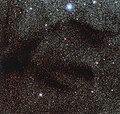
Dark nebula LDN 1768 contains protostars.[3]

Dark nebula called LDN1774, taken by the Wide Field Imager, an instrument mounted on ESO’s 2.2-meter MPG/ESO telescope at La Silla.[4]

Dark nebula LDN 483 is located about 700 light-years away in the constellation of Serpens (The Serpent).[5]

Lupus 4 is a dense pocket of gas and dust where new stars are expected to form.[6]


See also[edit]
- List of dark nebulae
- Bok globule
Notes[edit]
^ James Di Francesco et al., 2002, "Abundances of Molecular Species in Barnard 68", The Astronomical Journal, 124, 2749
^ ESO - eso9934 - Secrets of a Dark Cloud Archived 2009-02-04 at the Wayback Machine.
^ "All Quiet in the Nursery?". Retrieved 23 March 2016..mw-parser-output cite.citation{font-style:inherit}.mw-parser-output q{quotes:"""""""'""'"}.mw-parser-output code.cs1-code{color:inherit;background:inherit;border:inherit;padding:inherit}.mw-parser-output .cs1-lock-free a{background:url("//upload.wikimedia.org/wikipedia/commons/thumb/6/65/Lock-green.svg/9px-Lock-green.svg.png")no-repeat;background-position:right .1em center}.mw-parser-output .cs1-lock-limited a,.mw-parser-output .cs1-lock-registration a{background:url("//upload.wikimedia.org/wikipedia/commons/thumb/d/d6/Lock-gray-alt-2.svg/9px-Lock-gray-alt-2.svg.png")no-repeat;background-position:right .1em center}.mw-parser-output .cs1-lock-subscription a{background:url("//upload.wikimedia.org/wikipedia/commons/thumb/a/aa/Lock-red-alt-2.svg/9px-Lock-red-alt-2.svg.png")no-repeat;background-position:right .1em center}.mw-parser-output .cs1-subscription,.mw-parser-output .cs1-registration{color:#555}.mw-parser-output .cs1-subscription span,.mw-parser-output .cs1-registration span{border-bottom:1px dotted;cursor:help}.mw-parser-output .cs1-hidden-error{display:none;font-size:100%}.mw-parser-output .cs1-visible-error{font-size:100%}.mw-parser-output .cs1-subscription,.mw-parser-output .cs1-registration,.mw-parser-output .cs1-format{font-size:95%}.mw-parser-output .cs1-kern-left,.mw-parser-output .cs1-kern-wl-left{padding-left:0.2em}.mw-parser-output .cs1-kern-right,.mw-parser-output .cs1-kern-wl-right{padding-right:0.2em}
^ "A Hole in the Sky". Retrieved 14 June 2015.
^ "The dark nebula LDN 483". www.eso.org. European Southern Observatory. Retrieved 14 January 2015.
^ "Cosmic Forecast: Dark Clouds Will Give Way to Sunshine". www.eso.org. European Southern Observatory. Retrieved 8 September 2014.
Nebula | |
|---|---|
| |
| Visible nebula |
|
| Pre-stellar nebula |
|
| Stellar nebula |
|
| Post-stellar nebula |
|
| Clouds |
|
| Morphology |
|
| Lists |
|
| |
 List
List Category
 Commons
 Wiktionary
Star formation | ||
|---|---|---|
| Object classes |
|  |
| Theoretical concepts |
| |
| Star portal | ||
Authority control  |
|
|---|
Categories:
- Dark nebulae
- Nebulae
- Cosmic dust


(window.RLQ=window.RLQ||).push(function(){mw.config.set({"wgPageParseReport":{"limitreport":{"cputime":"0.248","walltime":"0.348","ppvisitednodes":{"value":686,"limit":1000000},"ppgeneratednodes":{"value":0,"limit":1500000},"postexpandincludesize":{"value":38494,"limit":2097152},"templateargumentsize":{"value":1294,"limit":2097152},"expansiondepth":{"value":11,"limit":40},"expensivefunctioncount":{"value":2,"limit":500},"unstrip-depth":{"value":1,"limit":20},"unstrip-size":{"value":14234,"limit":5000000},"entityaccesscount":{"value":1,"limit":400},"timingprofile":["100.00% 292.671 1 -total"," 36.14% 105.784 1 Template:Reflist"," 28.14% 82.359 4 Template:Cite_web"," 17.20% 50.330 1 Template:Clarify"," 15.35% 44.926 1 Template:Fix-span"," 11.08% 32.425 1 Template:Authority_control"," 8.44% 24.690 1 Template:See_also"," 8.35% 24.438 2 Template:Category_handler"," 7.00% 20.492 1 Template:Star_formation"," 6.37% 18.638 1 Template:Sidebar"]},"scribunto":{"limitreport-timeusage":{"value":"0.130","limit":"10.000"},"limitreport-memusage":{"value":4255069,"limit":52428800}},"cachereport":{"origin":"mw1267","timestamp":"20181016134807","ttl":1900800,"transientcontent":false}}});mw.config.set({"wgBackendResponseTime":86,"wgHostname":"mw1264"});});


