Locus (genetics)
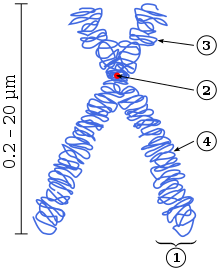
Chromosome components:
(1) Chromatid
(2) Centromere
(3) Short (p) arm
(4) Long (q) arm
A locus (plural loci) in genetics is a fixed position on a chromosome, like the position of a gene or a marker (genetic marker).[1] Each chromosome carries many genes; human's estimated 'haploid' protein coding genes are 19,000–20,000,[2] on the 23 different chromosomes. A variant of the similar DNA sequence located at a given locus is called an allele. The ordered list of loci known for a particular genome is called a gene map. Gene mapping is the process of determining the locus for a particular biological trait.
Diploid and polyploid cells whose chromosomes have the same allele of a given gene at some locus are called homozygous with respect to that gene, while those that have different alleles of a given gene at a locus are called heterozygous with respect to that gene.[3]
Contents
1 Nomenclature
2 Centisome
3 See also
4 References
5 External links
Nomenclature

Cytogenetic banding nomenclature
The shorter arm of a chromosome is termed the p arm or p-arm, while the longer arm is the q arm or q-arm. The chromosomal locus of a typical gene might be written 3p22.1, where
3 = chromosome 3
p = p-arm
22 = region 2, band 2 (read as "two, two", not "twenty-two")
1 = sub-band 1
Thus the entire locus of the example above would be read as "three P two two point one."
The cytogenetic bands count from the centromere out toward the telomeres.
| Component | Explanation |
| 3 | The chromosome number. |
| p | The position is on the chromosome's short arm (a common apocryphal explanation is that the p stands for petit in French); q indicates the long arm (chosen as next letter in alphabet after p; alternatively it is sometimes said that q stands for queue meaning tail in French). |
| 22.1 | The numbers that follow the letter represent the position on the arm: region 2, band 2, sub-band 1. The bands are visible under a microscope when chromosome is suitably stained. Each of the bands is numbered, beginning with 1 for the band nearest the centromere. Sub-bands and sub-sub-bands are visible at higher resolution. |

Example of bands
A range of loci is specified in a similar way. For example, the locus of gene OCA1 may be written "11q1.4-q2.1", meaning it is on the long arm of chromosome 11, somewhere in the range from sub-band 4 of region 1 to sub-band 1 of region 2.
The ends of a chromosome are labeled "pter" and "qter", and so "2qter" refers to the terminus of the long arm of chromosome 2.
Centisome
A centisome (not to be confused with a centrosome) is defined as 1% of a chromosome length.[4]
See also
- Chromosomal translocation
- Cytogenetic notation
- Karyotype
- Null allele
- International System for Human Cytogenetic Nomenclature
References
^ Wood, E.J. (1995). "The encyclopedia of molecular biology". Biochemical .Education. 23 (2): 1165. doi:10.1016/0307-4412(95)90659-2..mw-parser-output cite.citation{font-style:inherit}.mw-parser-output q{quotes:"""""""'""'"}.mw-parser-output code.cs1-code{color:inherit;background:inherit;border:inherit;padding:inherit}.mw-parser-output .cs1-lock-free a{background:url("//upload.wikimedia.org/wikipedia/commons/thumb/6/65/Lock-green.svg/9px-Lock-green.svg.png")no-repeat;background-position:right .1em center}.mw-parser-output .cs1-lock-limited a,.mw-parser-output .cs1-lock-registration a{background:url("//upload.wikimedia.org/wikipedia/commons/thumb/d/d6/Lock-gray-alt-2.svg/9px-Lock-gray-alt-2.svg.png")no-repeat;background-position:right .1em center}.mw-parser-output .cs1-lock-subscription a{background:url("//upload.wikimedia.org/wikipedia/commons/thumb/a/aa/Lock-red-alt-2.svg/9px-Lock-red-alt-2.svg.png")no-repeat;background-position:right .1em center}.mw-parser-output .cs1-subscription,.mw-parser-output .cs1-registration{color:#555}.mw-parser-output .cs1-subscription span,.mw-parser-output .cs1-registration span{border-bottom:1px dotted;cursor:help}.mw-parser-output .cs1-hidden-error{display:none;font-size:100%}.mw-parser-output .cs1-visible-error{font-size:100%}.mw-parser-output .cs1-subscription,.mw-parser-output .cs1-registration,.mw-parser-output .cs1-format{font-size:95%}.mw-parser-output .cs1-kern-left,.mw-parser-output .cs1-kern-wl-left{padding-left:0.2em}.mw-parser-output .cs1-kern-right,.mw-parser-output .cs1-kern-wl-right{padding-right:0.2em}
^ Ezkurdia, Iakes; Juan, David; Rodriguez, Jose Manuel; Frankish, Adam; Diekhans, Mark; Harrow, Jennifer; Vazquez, Jesus; Valencia, Alfonso; Tress, Michael L. (2014-11-15). "Multiple evidence strands suggest that there may be as few as 19,000 human protein-coding genes". Human Molecular Genetics. 23 (22): 5866–5878. doi:10.1093/hmg/ddu309. ISSN 1460-2083. PMC 4204768. PMID 24939910.
^ "NCI Dictionary of Genetics". National Cancer Institute. Retrieved 13 December 2014.
^ Peter D. Karp; Monica Riley (2009-01-11), Representations of Metabolic Knowledge (PDF)
Michael, R. Cummings. (2011). Human Heredity. Belmont, California: Brooks/Cole
External links
 | Wikimedia Commons has media related to Locus (genetics). |
 | Wikidata has the property:
|
 cytogenetic location (P4196) (see
 - Overview at ornl.gov
Chromosome Banding and Nomenclature from NCBI.


