Louise Lovely
Louise Lovely | |
|---|---|
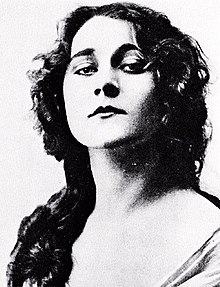 Undated headshot of Lovely | |
| Born | Nellie Louise Carbasse (1895-02-28)28 February 1895 Paddington, New South Wales, Australia |
| Died | 18 March 1980(1980-03-18) (aged 85) Hobart, Tasmania, Australia |
| Other names | Louise Carbasse Louise Welch |
| Years active | 1904–1925 |
| Spouse(s) |
|
Louise Lovely (born Nellie Louise Carbasse; 28 February 1895 – 18 March 1980) was an Australian film actress. She is credited by film historians for being the first Australian actress to have a successful career in Hollywood, signing a contract with Universal Pictures in the United States in 1914. Lovely would appear in a total of fifty American films and ten Australian films before retiring from acting in 1925.
Contents
1 Early life
2 Career
2.1 Early work
2.2 Hollywood films
2.3 Return to Australia
3 Personal life
4 Filmography
5 Notes
6 Footnotes
7 References
8 External links
Early life
Louise Lovely was born Nellie Louise Carbasse[1] in Paddington, Sydney to an Italian musician (and composer) father, Ferruccio Carlo Alberti (1844-1913), and a Swiss mother, Elise Louise Jeanne de Gruningen Lehmann (1860-1926),[2] who had come to Australia in 1891, in the company of Sarah Bernhardt, and had decided to remain in Sydney once Bernhardt had left Australia.[3] Louise Lovely made her professional debut at age nine as Eva in a stage production of the classic Uncle Tom's Cabin, using the name Louise Carbasse.[4]
Career
Early work
Lovely was acting with George Marlow's theatre company in Western Australia when she received a telegram from Gaston Mervale to appear in a series of movies for Australian Life Biograph Company.[5]
Hollywood films
In 1914, Lovely moved to the United States with her husband, hoping to replicate her Australian success, settling in Los Angeles, California.[1] In California, Lovely caught the attention of Universal Studios head Carl Laemmle who both gave her a contract with his studio and re-christened her Louise Lovely.[4] She made her American debut alongside the legendary Lon Chaney in Father and the Boys in 1915, receiving strong reviews.[6] She starred with Chaney again in several other films including her next release US film Stronger Than Death (1915) and The Gilded Spider and Tangled Hearts (both 1916).
Lovely became one of Universal's major early stars and a challenger to Mary Pickford's status as the golden girl of early silent cinema,[7] but was dropped by the studio in 1918 following a contract dispute. Though she was subsequently picked up by 20th Century Fox, where she starred in a series of Westerns with William Farnum, her career never reached its earlier heights. Over a course of four years, she had appeared in fifty American films.[7]
As a consequence of having her hair singed on an American movie set, she permanently changed her hair style from long flowing locks to a bob cut.[8]
Return to Australia
In 1924, Lovely and her husband returned to Australia in pursuit of a new interest - film production. Lovely had maintained a long-time interest in the behind-the-scenes aspects of film, and had collaborated with Welch on a successful short documentary feature, A Day At The Studio, but her plans for her return to Australia were far more ambitious. Lovely and Welch undertook a nationwide talent search to encourage budding new movie actresses. Over 23,000 actors and actresses attended Lovely's auditions, which included demonstrations of movie equipment and acting technique, and which took place at prestigious locations such as Melbourne's Princess Theatre. Twenty were selected to appear in Lovely's next film venture Jewelled Nights (1925), which was written and directed by herself and her husband.[9]
Based on the novel by Marie Bjelke Petersen, Jewelled Nights told the story of a young woman who escaped from an unhappy marriage, instead posing as a young man and finding refuge in a tough mining community, where she finds love with a fellow miner (played by Gordon Collingridge).[10] Though it was an outstanding success, it did not recoup its high costs. The Australian film industry, once one of the most productive in the world, was about to fall into a slump that was to last for fifty years. Lovely was offered no more roles and could not afford any further independent productions, and thus, Jewelled Nights was her last film. Today, very little of the film survives other than outtakes and stills.
Prior to the production of Jewelled Nights, between 1921 and 1925, Lovely and Welch traveled throughout the United States and Australia, leading “A Day at the Studio,” a traveling show in which audience members volunteered for on-stage "screen tests."[7]
Personal life
Lovely married to fellow actor Wilton Welch in February 1912,[11] when she was only sixteen years old, and relocated to the United States with him.[4] Lovely testified at the Royal Commission on the Moving Picture Industry in Australia, suggesting a number of measures that might stimulate the struggling local film industry. Soon afterwards, she made a return to the stage. It was at around this time that Lovely's marriage to Wilton Welch disintegrated; Welch was homosexual[12] and their marriage remained unconsummated for the first four years.[13] Lovely and Welch were divorced in November 1928.[14][15][4]
She married Melbourne theatre manager Albert Bertie Cowen,[16] known as "Bert Cowan", at the Melbourne Registry Office on Monday, 26 November 1928; the same day as her divorce was granted in Sydney.[17] Her marriage to Cowan lasted for the rest of her life.[4]
The couple moved to Hobart, Tasmania in 1946, where Cowan became the manager of the Prince of Wales Theatre.[18] Lovely managed the theatre's sweet shop, where she worked until her death in 1980.[19][20]
Filmography

Bobbie of the Ballet (1916).

With Hale Hamilton in Johnny on the Spot (1919).
 | Denotes a lost or presumed lost film.[a] |
| Year | Title | Role | Notes |
|---|---|---|---|
| 1911 | One Hundred Years Ago | Judith | As Louise Carbasse |
| 1911 | A Ticket in Tatts | Mrs. Fallon | As Louise Carbasse |
| 1911 | The Colleen Bawn | The Colleen | As Louise Carbasse |
| 1911 | A Tale of the Australian Bush | Mrs. Hall | As Louise Carbasse |
| 1912 | Hands Across the Sea | As Louise Carbasse | |
| 1912 | A Daughter of Australia | As Louise Carbasse | |
| 1912 | Conn, the Shaughraun | As Louise Carbasse | |
| 1912 | The Wreck of the Dunbar or The Yeoman's Wedding | Short film; as Louise Carbasse | |
| 1912 | The Ticket of Leave Man | As Louise Carbasse | |
| 1915 | Father and the Boys | Bessie Brayton | |
| 1915 | Stronger Than Death | June Lathrop | |
| 1915 | The Measure of a Man | Pattie Batch | |
| 1916 | Dolly's Scoop | Dolly Clare | Short film; as Louise Welch |
| 1916 | The Grip of Jealousy | Virginia Grant | |
| 1916 | Tangled Hearts | Vera Lane | |
| 1916 | The Gilded Spider | Leonita & Elisa | |
| 1916 | The Grasp of Greed | Alice Gordon | |
| 1916 | Bobbie of the Ballet | Bobbie Brent | |
| 1916 | Bettina Loved a Soldier | Bettina Scott | |
| 1916 | The Social Buccaneer | Marjorie Woods | |
| 1916 | Stronger Than Steel | Daphne of the Follies | Short film |
| 1917 | Blood Money | Belle Blaire | Short film |
| 1917 | The Fugitive | Nan Donovan | Short film |
| 1917 | The Diamonds of Destiny | Jane Lowe | Short film |
| 1917 | The Outlaw and the Lady | Ruth Carter | Short film |
| 1917 | The Fourth Witness | Margaret Bryant | Short film |
| 1917 | The Gift Girl | Rokaia | Short film |
| 1917 | The Grip of Love | Ruth Overholt | Short film |
| 1917 | Her Great Dilemma | Mary Blanton | Short film |
| 1917 | The Field of Honor | Laura Sheldon | |
| 1917 | Her Strange Experience | Marie | Short film |
| 1917 | The Reed Case | Helen Reed | |
| 1917 | Sirens of the Sea | Lorelei | |
| 1918 | The Wolf and His Mate | Bess Nolan | |
| 1918 | Painted Lips | Lou McTavish[21] | |
| 1918 | Nobody's Wife | Hope Ross | |
| 1918 | The Girl Who Wouldn't Quit | Joan Tracy | |
| 1918 | A Rich Man's Darling | Julie Le Fabrier | |
| 1919 | Life's a Funny Proposition | Mary Austin | |
| 1919 | Johnny-on-the-Spot | Ann Travers | |
| 1919 | The Man Hunter | Helen Garfield | |
| 1919 | The Usurper | Beatrice Clive | |
| 1919 | The Lone Star Ranger | Ray Longstreth[22] | |
| 1919 | Wolves of the Night | Isabel Hollins | |
| 1919 | The Last of the Duanes | Jenny Lee | |
| 1919 | Wings of the Morning | Iris Deane | |
| 1920 | The Third Woman | Eleanor Steele | |
| 1920 | The Butterfly Man | Bessie Morgan | |
| 1920 | The Orphan | Helen Fields | |
| 1920 | The Twins of Suffering Creek | Little Casino | |
| 1920 | The Joyous Troublemaker | Beatrice Corlin | |
| 1920 | The Skywayman | Grace Ames | |
| 1920 | The Little Grey Mouse | Beverly Arnold | |
| 1921 | Partners of Fate | Helen Meriless | |
| 1921 | While the Devil Laughs | Mary Franklin | |
| 1921 | The Old Nest | Kate at 21–31 | |
| 1921 | The Heart of the North | Patricia Graham | |
| 1921 | The Poverty of Riches | Grace Donaldson | |
| 1921 | Life's Greatest Question | Nan Cumberland | |
| 1922 | Shattered Idols | Diana Chichester | |
| 1925 | Jewelled Nights | Elaine Fleetwood |
Notes
^ Status of films deemed lost is adapted from Lovely's entry in the Women Film Pioneers Project at Columbia University. According to the project, only nine films of Lovely are extant, five of which are feature films.[7]
Footnotes
^ ab Vieth & Moran 2005, p. 181.
^ Madame Alberti, The Sydney Morning Herald, (Monday, 16 August 1926), p.12; Deaths: Alberti, The Sydney Morning Herald, (Monday, 16 August 1926), p.10.
^ Louise Lovely, Table Talk, (Thursday, 16 October 1924), p.49.
^ abcde "Louise Nellie Lovely". Australian Dictionary of Biography. Retrieved 27 June 2017..mw-parser-output cite.citation{font-style:inherit}.mw-parser-output .citation q{quotes:"""""""'""'"}.mw-parser-output .citation .cs1-lock-free a{background:url("//upload.wikimedia.org/wikipedia/commons/thumb/6/65/Lock-green.svg/9px-Lock-green.svg.png")no-repeat;background-position:right .1em center}.mw-parser-output .citation .cs1-lock-limited a,.mw-parser-output .citation .cs1-lock-registration a{background:url("//upload.wikimedia.org/wikipedia/commons/thumb/d/d6/Lock-gray-alt-2.svg/9px-Lock-gray-alt-2.svg.png")no-repeat;background-position:right .1em center}.mw-parser-output .citation .cs1-lock-subscription a{background:url("//upload.wikimedia.org/wikipedia/commons/thumb/a/aa/Lock-red-alt-2.svg/9px-Lock-red-alt-2.svg.png")no-repeat;background-position:right .1em center}.mw-parser-output .cs1-subscription,.mw-parser-output .cs1-registration{color:#555}.mw-parser-output .cs1-subscription span,.mw-parser-output .cs1-registration span{border-bottom:1px dotted;cursor:help}.mw-parser-output .cs1-ws-icon a{background:url("//upload.wikimedia.org/wikipedia/commons/thumb/4/4c/Wikisource-logo.svg/12px-Wikisource-logo.svg.png")no-repeat;background-position:right .1em center}.mw-parser-output code.cs1-code{color:inherit;background:inherit;border:inherit;padding:inherit}.mw-parser-output .cs1-hidden-error{display:none;font-size:100%}.mw-parser-output .cs1-visible-error{font-size:100%}.mw-parser-output .cs1-maint{display:none;color:#33aa33;margin-left:0.3em}.mw-parser-output .cs1-subscription,.mw-parser-output .cs1-registration,.mw-parser-output .cs1-format{font-size:95%}.mw-parser-output .cs1-kern-left,.mw-parser-output .cs1-kern-wl-left{padding-left:0.2em}.mw-parser-output .cs1-kern-right,.mw-parser-output .cs1-kern-wl-right{padding-right:0.2em}
^ "SUNBURN FRECKLES AND TAN". Sunday Times (Perth, WA : 1902 - 1954). Perth, WA: National Library of Australia. 10 March 1912. p. 26. Retrieved 26 January 2012.
^ "LOUISE LOVELY". The Prahran Telegraph (Vic. : 1914 - 1918). Vic.: National Library of Australia. 6 January 1917. p. 8. Retrieved 24 March 2012.
^ abcd Delamoir, Jeanette. "Louise Lovely". Women Film Pioneers Project. Columbia University. Retrieved 27 June 2017.
^ Maher, Louise, "Silent film star Louise Lovely's 1916 fan letter and photos acquired by National Archive", ABC Radio Canberra, Wednesday, 4 April 2018.
^ Blonski, Creed & Freiberg 1987, p. 28.
^ Sanders, Anne, "Jewelled Nights", Portrait Magazine, No.56, National Portait Gallery, 6 March 2017.
^ Mr. Wilton Welch and Mademoiselle Louise Carbasse, Table Talk, (Thursday, 29 February 1912), p.8; Marriages: Welch—Carbasse Alberti, The Sydney Morning Herald, (Tuesday, 27 February 1912), p.8.
^ Gillard, Garry (13 December 2012). "Louise Lovely (and Wilton Welch)". Australasian Cinema. Retrieved 27 June 2017.
^ O'Brien, Phillip (17 April 1999). "Lee makes the right choice as Louise". Canberra Times. Panorama. p. 20.
^ In Divorce: Welch v Welch, The Sydney Morning Herald, (Friday, 3 September 1926), p.8; Miss Louise Lovely: Wants Her Husband Back, The (Adelaide) Advertiser, (Friday, 3 September 1926), p.16; Not so Lovely now, The (Sydney Truth, (Sunday, 5 September 1926), p.17.
^ "The decree nisi granted in the suit of Nellie Louise Welch v William Harry Welch, was made absolute, and the marriage declared dissolved": In Divorce, The Sydney Morning Herald, (Tuesday, 27 November 1928), p.8.
^ 1924 prosecution has "Andrew Bertie Cowen" (Traffic Prosecutions, The Argus, (Monday, 26 May 1924), p.17); and the Victorian marriage record (registration no.11739 of 1928) has "Nellie Louise Alberti" and "Andrew Bertie Cowen".
^ Miss Lovely Gets Divorce: Marries Again on the Same day, The Northern Territory Times, (Tuesday, 27 November 1928), p.5. Miss Louise Lovely: Married in Melbourne, The (Adelaide) Advertiser, Tuesday, 27 November 1928), p.15; Topics of Feminine Interest: Louise Loveley's Wedding, The Countryman, (Friday, 30 November 1928), p.10; Theatrical Party Filmed, The Mercury, (Friday, 8 February 1929), p.5.
^ Theatre Director Entertained, The Mercury, (Tuesday, 1 February 1949), p.6.
^ McIntyre, Paul, "Louise Lovely: The silent film star who tried to bring Hollywood to Tasmania", ABC Radio Hobart, 10 September 2017.
^ Actress Dies, The Canberra Times, (Thursday, 20 March 1980), p.3.
^ "Features Scheduled for April". Motography. 19 (1–26): 217. 2 February 1918 – via Google Books.
^ Wenzell, Nicolette (April 3, 2016). "1919 movie 'The Lone Star Ranger' shot in Palm Springs". The Desert Sun. Gannett.
References
Blonski, Annette; Creed, Barbara; Freiberg, Freda (1987). Don't Shoot Darling!: Women's Independent Filmmaking in Australia. Spinifex Press. ISBN 978-0-864-36058-8.
- Delamoir, Marie Jeanette, Louise Lovely: The Construction of a Star, Ph.D. Dissertation, Latrobe University, 2002.
Vieth, Errol; Moran, Albert (2005). Historical Dictionary of Australian and New Zealand Cinema. Scarecrow Press. ISBN 978-0-810-86527-3.
External links
 | Wikimedia Commons has media related to Louise Lovely. |
Louise Lovely on IMDb
Louise Lovely at the Women Film Pioneers Project- Louise Lovely at the National Film and Sound Archive
Louise Lovely, Significant Women Project (Tasmanian Government)- Australian Dictionary of Biography
Authority control  |
|
|---|


