Aero Commander 500 family
| Aero Commander twins | |
|---|---|
 | |
| Aero Commander model 695A operated by the US National Oceanic and Atmospheric Administration | |
| Role | Utility and business aircraft |
| Manufacturer | Aero Design and Engineering Company Aero Commander Rockwell-Standard Corporation North American Rockwell Rockwell International Gulfstream Aerospace |
| First flight | 23 April 1948 (Model L3085) |
| Introduction | October 1952 |
| Produced | 1951-1986 |
The Aero Commander 500 family is a series of light-twin piston-engined and turboprop aircraft originally built by the Aero Design and Engineering Company in the late 1940s, renamed the Aero Commander company in 1950, and a division of Rockwell International from 1965. The initial production version was the 200-mph, seven-seat Aero Commander 520. An improved version, the 500S, manufactured after 1967, is known as the Shrike Commander. Larger variants are known by numerous model names and designations, ranging up to the 330-mph, 11-seat Model 695B/Jetprop 1000B turboprop.[1]
Contents
1 Design and development
2 Operational history
2.1 Safety concerns
2.1.1 Single-engine safety
2.1.1.1 Single-engine flight to Washington
2.1.1.2 NTSB Single-engine safety study
2.1.1.3 Hoover single-engine airshow routine
2.1.1.4 Turboprop Commanders' single-engine safety
2.1.2 Wing spar fatigue
2.2 Notable accidents
3 Variants
4 Operators
4.1 Military operators
4.2 Civilian operators
5 Specifications (Rockwell Aero Commander 500S)
6 See also
7 References
7.1 Notes
7.2 Bibliography
8 External links
Design and development

Updated Aero Commander Panel
The idea for the Commander light business twin was conceived by Ted Smith, a project engineer at the Douglas Aircraft Company.[2] Working part-time after hours throughout 1944, a group of A-20 engineers formed the Aero Design and Engineering Company to design and build the proposed aircraft with a layout similar to their A-20 bomber.[2][3] Originally, the new company was going to build three pre-production aircraft, but as the first aircraft was being built, they decided to build just one prototype.[2] The final configuration was completed in July 1946 and was designated the Model L3805.[2]
Registered NX1946, the prototype first flew on 23 April 1948.[2] The L3805 accommodated up to five people and was powered by two Lycoming O-435-A piston engines.,[1] it was an all-metal high-wing monoplane with retractable undercarriage using components from a Vultee BT-13 Valiant. The market segment planned for this aircraft to be sold to small feeder airliner firms and was originally designed to carry seven passengers, but instead found use in the private business aircraft and military market.[4]Walter Beech test flew the aircraft in 1949 and expressed interest in buying the project, but passed on it, to instead develop the Beechcraft Twin Bonanza. Fairchild Aircraft also evaluated the prototype at its Hagerstown, Maryland, headquarters.[3]
The prototype flew successfully and the company leased, at no cost, a new 26,000 square-foot factory at Bethany near Oklahoma City to build a production version, certified on 30 June 1950. Nearly 10,000 hours of redesign work went into the model, including more powerful Lycoming GO-435-C2 engines, with a combined rating of 520 horsepower. The production model was named the Commander 520. The first Commander 520 was rolled out of the new factory in August 1951. Serial number 1 was used as a demonstrator, then sold in October 1952 to the Asahi Shimbun Press Company of Tokyo.
Operational history
In military service, it was initially designated the L-26, though in 1962 this was changed to U-4 for the United States Air Force and U-9 for the United States Army.

Bob Hoover's Shrike Commander on display
Under ownership of Rockwell in the 1960s, World War II pilot R. A. "Bob" Hoover demonstrated the Shrike Commander 500S for decades in a variety of "managed energy" routines, including single-engine and engine-out aerobatics.[5][6] His Shrike Commander is displayed in the colors of his last sponsor, Evergreen International Aviation, at the Steven F. Udvar-Hazy Center of the Smithsonian Air and Space Museum. Bob Odegaard continued the tradition in 2012, flying a 1975 Shrike 500S in a Bob Hoover tribute routine.[7]
One U-4B became a presidential transport aircraft for Dwight D. Eisenhower between 1956 and 1960. This was the smallest "Air Force One," and the first to wear the now-familiar blue-and-white livery.
As of 2004, Shrike Commanders remained in service with the United States Coast Guard and United States Customs Service.[1]
A single 560F was operated by the Belgian Air Force as the personal transport of the late king Boudewijn from 1961 to 1973.[8]
The unpressurized, long-fuselage 680FL was operated as a small package freighter by Combs Freightair in the 1970s and 1980s, and by Suburban Air Freight in the 1980s and 1990s. The aircraft was popular with pilots, because it was extremely "pilot friendly" and with its 380 hp supercharged engines did well in icing meteorological conditions. A number are still operated on contracts for cargo and fire control applications, as their piston engines offer good fuel specifics at low altitudes and longer loiter times.
Safety concerns
Single-engine safety
Single-engine flight to Washington
In 1950, when the developers were working to satisfy Civil Aeronautics Authority (CAA) regulations for certification of the 500, they chose a novel method of demonstrating its single-engine safety and performance: they removed one of the two-bladed propellers, secured it in the aft cabin, and flew from Bethany to Washington, D.C. on one engine. There they met with CAA personnel, then replaced the propeller and returned to Oklahoma in the conventional manner. The flight received nationwide coverage in the press.[9][10]
However, the stunt had been performed with the propeller stowed inside the aircraft, rather than dragging in the open on the front of the engine (as would happen in an actual engine failure). Consequently, the famous demonstration did not demonstrate an actual failed-engine scenario (in which the propeller normally creates substantial drag, and adds to single-engine control and performance problems).[9][10][11]
NTSB Single-engine safety study
In fact, in a 1979 government study of light-twin engine-failure accident rates, reviewing accidents involving the 24 most popular model-groups of light twins between 1972 and 1976, the National Transportation Safety Board found that the piston-engined twin-Commanders had, by far, the worst number of engine-failure accidents, per hundred-thousand hours flown, of any popular light-twin model -- except for Piper's notoriously underpowered small-engine versions of the out-of-production Piper Apache (barely able to function on one engine).[12][13]
The piston-powered Aero Commanders averaged slightly over 3.4 engine-failure accidents per hundred-thousand hours (vs. 6.9 for the Apache, and 2.9 for the next-worst, the Beechcraft Travel Air; the overall average for all models was only 1.6).[12][13]
Hoover single-engine airshow routine
Countering the statistical evidence, Rockwell demonstration pilot Bob Hoover's famous airshow stunt routine, with the Shrike Commander, included a full aerobatic routine performed first with both engines, then with one engine out (and the critical engine, at that), then both engines out, gliding.[14][15][check quotation syntax]
Turboprop Commanders' single-engine safety
The turboprop twin-Commanders -- with much more powerful engines (and most with longer bodies, allowing greater rudder leverage, critical for single-engine control[10][11]) -- came out on the opposite end of the rankings, with one of the lowest rates of engine-failure accidents of all "light" twins examined, at only 0.4 per hundred-thousand hours.[12]
Wing spar fatigue
Beginning in June 1991, senior engineers met with FAA officials to discuss concerns over the Aero Commander's main wing spar, which was believed to be susceptible to stress fatigue and subsequent cracking, and was believed to have resulted in a number of fatal crashes.[16]
From approximately 1961 to 1993, 24 aircraft crashed when spar failures caused the loss of the wing in flight.[16] Thirty-five more spars were found cracked during inspections.[16]
Notable accidents
- On 19 June 1964, Senator Ted Kennedy was a passenger in an Aero Commander 680 airplane flying in bad weather from Washington, D.C., to Massachusetts. It crashed into an apple orchard in the western Massachusetts town of Southampton on the final approach to the Barnes Municipal Airport near Westfield.[17][18] The pilot and Edward Moss, one of Kennedy's aides, were killed.[19] Kennedy suffered a severe back injury, a punctured lung, broken ribs and internal bleeding.[20]
- World War II hero and actor Audie Murphy died in an Aero Commander 680 crash while flying as a passenger on 28 May 1971. The aircraft was flying in bad weather at night and was on approach to Roanoke, Virginia when it flew into the side of Brush Mountain outside Blacksburg, Virginia, West of Roanoke. Four others and the pilot were also killed.[21]
- On 11 August 2002, photographer Galen Rowell, his wife Barbara Cushman Rowell, pilot Tom Reid, and Reid's friend Carol McAffee were killed in an Aero Commander 690 crash near Eastern Sierra Regional Airport in Bishop, California.[22]
Variants

Aero Commander 560 at Centennial Airport

Aero Commander 500-B at Colorado Springs Airport

Aero Commander 500U Shrike Commander
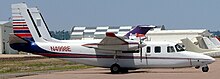
Aero Commander 680FL at Colorado Springs Airport

Aero Commander 680W at Eagle County Regional Airport
- Aero Commander L.3805
- Prototype, one built, Lycoming O-435-A engines.
- Aero Commander 520
- First production version, a developed L.3805 with a taller fin and larger cabin with two 260 hp Lycoming GO-435-C engines, 150 built.
- Aero Commander 560
- Model 520 with swept tail, increased takeoff weight, seven seats and more powerful engines (two 270 hp Lycoming GO-480B engines) and refined wing,[23] 80 built.
- Aero Commander 560A
- New undercarriage, stretched fuselage and other numerous refinements, 99 built.
- Aero Commander 560E
- Larger wings and greater payload, 93 built.
- Aero Commander 560F
- Powered with 350 hp Lycoming IGO-540 engines.
- Aero Commander 360
- Lightened version of the 560E with four seats and two 180 hp engines, one built.
- Aero Commander 500
- Economy version introduced in 1958, a 560E with 250 hp Lycoming O-540-A engines, 101 built.
- Aero Commander 500A
- First Aero Commander model – new nacelles to house 260 hp fuel-injected Continental IO-470M engines, 99 built.[24]
- Aero Commander 500B
- 500A with 290 hp fuel injected Lycoming IO-540 engines, 217 built.
- Aero Commander 500U/Shrike Commander
- 500B with pointed nose and squared off tail, two 290 hp Lycoming IO-540 engines, replaced 500A, 500B, 560F and 680F, 56 built.
- Aero Commander 500S/Shrike Commander
- 500U with minor changes, 316 built.[25]
- Aero Commander 680 Super
- Development of 560A with supercharged 340 hp Lycoming GSO-480-A engines and increased fuel capacity, 254 built.
- Aero Commander 680E
- Lightened 560E and 560A type undercarriage, 100 built.
- Aero Commander 680F
- 680E with new undercarriage and supercharged, fuel-injected 380 hp Lycoming IGSO-540 engines and new nacelles, 126 built.
- Aero Commander 680FP
Pressurized version modified from 680F, 26 built.- Aero Commander 680FL Grand Commander
- 680F with stretched fuselage and larger tail, 157 built. After 1967 known as the Courser Commander.
- Aero Commander 680FL/P Grand Commander
Pressurized version of 680FL, 37 built.- Aero Commander 680T Turbo Commander
- 680FL/P with Garrett TPE331-43 turboprop engines, 56 built.
- Aero Commander 680V Turbo Commander
- 680T with increased takeoff weight and slightly improved cargo capacity, 36 built.
- Aero Commander 680W Turbo II Commander
- 680V with pointed nose. squared off fin, one panoramic and two small cabin windows and weather radar, 46 built.
- Aero Commander 695A Turbo Commander
- Built for the National Oceanic and Atmospheric Administration.

1969 Aero Commander 681
- Rockwell 681 Hawk Commander
- 680W with improved pressurisation, air conditioning system and nose, 43 built.
- Rockwell 681B Turbo Commander
- Marketing designation for economy version of the 681, 29 built.
- Rockwell 685 Commander
- 690 powered by two 435 hp Continental GTSIO-520K piston engines, 66 built.
- Commander 690
- 681 with new wing centre section and engines moved further outboard, two Garrett AiResearch TPE331-5-251K turboprops, 79 built.
- Commander 690A
- 690 with changed flightdeck layout and increased pressurisation, 245 built.
- Commander 690B
- 690A with improved soundproofing and internal lavatory, 217 built.
690C Jetprop 840- 690B with increased wingspan, wet wing fuel tanks and winglets, two 840shp TPE331-5-254K turboprops, 136 built.
- 690D Jetprop 900
- Similar to 690C with internal rear cabin extension, improved pressurisation and five square cabin windows, 42 built.
- 695 Jetprop 980
- Similar to 690C with 735shp TPE331-10-501K engines, 84 built.
- 695A Jetprop 1000
- 690D with higher takeoff weight and more powerful TPE331-10-501K engines, 101 built.
- 695B Jetprop 1000B
- 695A with minor changes, 6 built.
- Aero Commander 720 AltiCruiser
- Pressurized version of 680, 13 built.
- YL-26 → YU-9A
- Aero Commander 520 evaluated by the US Army, 3 built.
- YL-26A
- Aero Commander 560 evaluated by the US Air Force, 1 built.
- L-26B → U-4A
- Aero Commander 560A sold to the US Air Force, 14 built.

U-4B

L-26C
- L-26B → U-9B
- Aero Commander 560A sold to the US Army, 1 built.
- L-26C → U-4B
- Aero Commander 680 Super sold to the US Air Force, 2 built.
- L-26C → U-9C
- Aero Commander 680 Super sold to the US Army, 4 built.
- RL-26D → RU-9D
- Commander 680 for US Army aircraft fitted with SLAR (side looking airborne radar), two built.
- NL-26D → NU-9D
- One built.
Operators
Military operators
 Argentina

Argentine Air Force - 1 x 500B, 27 x 500U and 1 x 680 [26]
Argentine Army Aviation - 680V, 690A [27]
 Benin
Benin

Benin Air Force - 1 x 500B[28]
 Colombia

National Army of Colombia[29]
 Greece

Hellenic Army - 2 x 680FL[30]
 Indonesia

Indonesian Army Aviation - 2 x 680FL[31]
 Iran
Iran

Islamic Republic of Iran Air Force - 3 x 681B[32]
Islamic Republic of Iran Army Aviation - 3 x 690, 2 x 690A[33]
Islamic Republic of Iran Navy Aviation - 2 x 500S, 2 x 690, 6 x 690A[34]
 Ivory Coast

Ivory Coast Air Force - 1 x 500B[35]
 Kenya
Kenya

Kenya Air Force - 1 x 680FP (no longer operated)[36]
 Kingdom of Laos

Royal Lao Air Force - 1 x 560 (no longer operated)[37]
 South Korea

Republic of Korea Air Force - 3 x 520, 2 x 560F[38]
 Mexico

Mexican Air Force - 20 x 500S[39]
 Niger
Niger

Niger Air Force - 1 x 500B[40]
 Pakistan

Pakistan Air Force - 1 x 680E (with radar nose), 1 x 680F[41]
Pakistan Army Aviation - 1 x 690B[42]
 Philippines

Philippine Air Force - 1 x 690 [43]
 United States

United States Air Force as the L-26 and U-4[44]
United States Army as the L-26 and U-9[44]
Civilian operators

An Iranian Police Aviation Aero Commander 690 flying over Tehran in 2009
Iran
- Iranian Police Aviation
United States
Texas Highway Patrol[45]
Specifications (Rockwell Aero Commander 500S)
Data from Jane's All The World's Aircraft 1976–77[46]
General characteristics
Crew: Two
Capacity: four passengers
Length: 36 ft 9¾ in (11.22 m)
Wingspan: 49 ft 0½ in (14.95 m)
Height: 14 ft 6 in (4.42 m)
Wing area: 255 ft² (23.69 m²)
Airfoil: NACA 23012 modified
Aspect ratio: 9.45:1
Empty weight: 4,635 lb (2,102 kg)
Max. takeoff weight: 6,750 lb (3,062 kg)
Powerplant: 2 × Lycoming IO-540-E1B5 air-cooled flat-six piston engines, 290 hp (216 kW) each
Performance
Maximum speed: 215 mph (187 knots, 346 km/h) at sea level (TAS)
Cruise speed: 203 mph (176 knots, 326 km/h) at 9,000 ft (2,750 m), 75% power, TAS
Stall speed: 68 mph (59 knots, 109 km/h) flaps and landing gear down, CAS
Minimum controllable speed: 75 mph (65.5 knots, 121 km/h)
Range: 1,078 miles (936 nmi, 1,735 km)
Service ceiling: 19,400 ft (5,913 m)
Rate of climb: 1,340 ft/min (6.8 m/s)
See also
- Bob Hoover
- Partenavia P.68
References
Notes
^ abc
"Rockwell U-9A Aero Commander". March Field Air Museum. Archived from the original on 18 August 2007. Retrieved 1 August 2007..mw-parser-output cite.citation{font-style:inherit}.mw-parser-output q{quotes:"""""""'""'"}.mw-parser-output code.cs1-code{color:inherit;background:inherit;border:inherit;padding:inherit}.mw-parser-output .cs1-lock-free a{background:url("//upload.wikimedia.org/wikipedia/commons/thumb/6/65/Lock-green.svg/9px-Lock-green.svg.png")no-repeat;background-position:right .1em center}.mw-parser-output .cs1-lock-limited a,.mw-parser-output .cs1-lock-registration a{background:url("//upload.wikimedia.org/wikipedia/commons/thumb/d/d6/Lock-gray-alt-2.svg/9px-Lock-gray-alt-2.svg.png")no-repeat;background-position:right .1em center}.mw-parser-output .cs1-lock-subscription a{background:url("//upload.wikimedia.org/wikipedia/commons/thumb/a/aa/Lock-red-alt-2.svg/9px-Lock-red-alt-2.svg.png")no-repeat;background-position:right .1em center}.mw-parser-output .cs1-subscription,.mw-parser-output .cs1-registration{color:#555}.mw-parser-output .cs1-subscription span,.mw-parser-output .cs1-registration span{border-bottom:1px dotted;cursor:help}.mw-parser-output .cs1-hidden-error{display:none;font-size:100%}.mw-parser-output .cs1-visible-error{font-size:100%}.mw-parser-output .cs1-subscription,.mw-parser-output .cs1-registration,.mw-parser-output .cs1-format{font-size:95%}.mw-parser-output .cs1-kern-left,.mw-parser-output .cs1-kern-wl-left{padding-left:0.2em}.mw-parser-output .cs1-kern-right,.mw-parser-output .cs1-kern-wl-right{padding-right:0.2em}
^ abcde Collman, B.J. (May–June 1973). "The Aero Commander Twins". Air-Britain Digest. 15 (3): 79–86.
^ ab Nicholis M Williams (Spring 1990). "The Aero Commander 520". AAHS Journal.
^ "Feederliner Makes Debut." "Popular Science, August 1948, p. 90, bottom of page. Note: First photos seems to indicate first model was to have fixed landing gear.
^ "Shrike Commander". Flying. July 1972. pp. 72–73, 76.
^ Collins, Richard L. (January 1999). "Grand Renaissance: The rebirth of the tough bird". Flying. Vol. 126 no. 1. pp. 80–83.
^ "none". Sport Aviation: 30. June 2011.
^ [1] Archived 17 February 2010 at the Wayback Machine.
^ ab Harris, Richard. "The Aero Commander Line – A short history". Archived from the original on 13 July 2011. Retrieved 13 August 2011.
^ abc Smith, T. M., "Multiengine Airplane Rating", 2nd Ed., Zweng / Pan American Navigation Service, North Hollywood, California, 1968.
^ ab "Checkout in a Multiengine Airplane", excerpted from Flight Training Handbook, Advisory Circular 61-21A, Federal Aviation Administration, at website of Aircraft Owners and Pilots Association, retrieved 17 May 2017
^ abc Special Study: "Light Twin-Engine Aircraft Accidents Following Engine Failures, 1972-1976," NTSB-AAS-79-2, 1979, National Transportation Safety Board, Washington, D.C., as retrieved from ERAU Library, 16 May 2017
^ ab Ibold, Ken, ed., Aviation Consumer's Used Aircraft Guide, 9th Edition, vol. 2, 2001, Belvoir Publications, Greenwich, Connecticut
^ Cochrane, Dorothy, "Robert A_ “Bob” Hoover, The Greatest Stick and Rudder Man, is Honored in Hollywood National Air and Space Museum.htm", 20 February 2014, Smithsonian National Air and Space Museum, Washington, D.C., retrieved 16 May 2017
^ ["Bob Hoover flies west,"] 25 October 2016, General Aviation News retrieved May, 15, 2017
^ abc Swift, S. J. (1 May 1995), The Aero Commander Chronicle (PDF), Civil Aviation Safety Authority, retrieved 1 August 2007
^ "Teddy's Ordeal". Time. 26 June 1964. Retrieved 23 May 2008.
^ "The Luck of the Kennedys". Check-Six.com. 8 May 2008. Archived from the original on 1 February 2009. Retrieved 24 February 2009.
^ "John F. Kennedy Jr. – Timeline: Misfortunes of a Family". CNN. July 1999. Archived from the original on 23 March 2008. Retrieved 23 May 2008.
^ Swidey, Neil (16 February 2009). "Chapter 2: The Youngest Brother: Turbulence and tragedies eclipse early triumphs". The Boston Globe. Archived from the original on 22 February 2009. Retrieved 24 February 2009.
^ "Biography for Audie Murphy". IMDb. 1 August 2007. Retrieved 1 August 2007.
^ Ray Delgado (12 August 2002). "Galen Rowell 1940-2002". sfgate.com. Hearst Communications Inc. Retrieved 27 November 2016.
^ "none". Flying Magazine: 38. August 1954.
^ "none". Flying Magazine: 23. November 1962.
^ Simpson 1995
^ Andrade 1982, p. 12
^ Andrade 1982, p. 13
^ Andrade 1982, p. 26
^ "División de Aviación Asalto Aéreo incorpora nuevo avión Turbo Commander 690D". webinfomil.com. Retrieved 19 December 2016.
^ Andrade 1982, p. 94
^ Andrade 1982, p. 106
^ Andrade 1982, p. 107
^ Andrade 1982, p. 109
^ Andrade 1982, p. 110
^ Andrade 1982, p. 126
^ Andrade 1982, p. 141
^ "Royal Lao Air Force Aircraft Types". aeroflight.co.uk. Retrieved 19 December 2016.
^ Andrade 1982, p. 143
^ Andrade 1982, p. 156
^ Andrade 1982, p. 167
^ Andrade 1982, p. 172
^ Andrade 1982, p. 173
^ "World Air Forces 2013" (PDF). Flightglobal Insight. 2013. Retrieved 12 March 2013.
^ ab Andrade 1979, p. 134
^ Team, DPS Web. "TxDPS - Aircraft History". www.dps.texas.gov. Retrieved 27 August 2018.
^ Taylor 1976, pp. 346–347.
Bibliography
Andrade, John (1979). U.S.Military Aircraft Designations and Serials since 1909. Midland Counties Publications. ISBN 0-904597-22-9.
Andrade, John (1982). Militair 1982. London: Aviation Press Limited. ISBN 0-907898-01-7.
Simpson, R. W. (1995). Airlife's General Aviation. Airlife Publishing. ISBN 1-85310-577-5.
Taylor, John W. R. (1976). Jane's All The World's Aircraft 1976–77. London: Jane's Yearbooks. ISBN 0-354-00538-3.
External links
 Media related to Aero Commander aircraft at Wikimedia Commons


