Guimet Museum

The Guimet Museum in Paris, 2005.
The Guimet Museum (French: Musée national des arts asiatiques [MNAAG] or Musée Guimet) is an art museum located at 6, place d'Iéna in the 16th arrondissement of Paris, France. It has one of the largest collections abroad of Asian art.
Contents
1 History
2 Works of art of the museum
2.1 Greco-Buddhist art
2.2 Serindian art
2.3 Chinese art
2.4 Indian art
2.5 Southeast Asian art
3 See also
4 Notes
5 External links
History
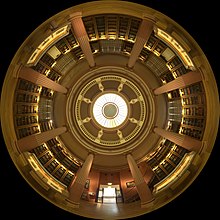
Panoramic view of the library in the Guimet Museum.
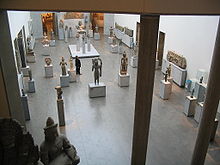
Founded by Émile Étienne Guimet, an industrialist, the museum first opened at Lyon in 1879[1] but was later transferred to Paris, opening in the place d'Iéna in 1889.[2] Devoted to travel, Guimet was in 1876 commissioned by the minister of public instruction to study the religions of the Far East, and the museum contains many of the fruits of this expedition, including a fine collection of Chinese and Japanese porcelain and many objects relating not merely to the religions of the East but also to those of ancient Egypt, Greece and Rome. One of its wings, the Panthéon Bouddhique, displays religious artworks.
Some of the museum's artifacts were collected from Southeast Asia by French authorities during the colonial period.[3]
From December 2006 to April 2007, the museum harboured collections of the Kabul Museum, with archaeological pieces from the Greco-Bactrian city of Ai-Khanoum, and the Indo-Scythian treasure of Tillia Tepe.
Works of art of the museum
Greco-Buddhist art
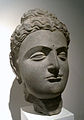
Gandhara Buddha, 1st-2nd century CE.

Hellenistic decorative scrolls from Hadda, northern Afghanistan.

Standing Buddha, ancient region of Gandhara, northern Afghanistan, 1st century.

Stone palette of a Nereid sea-goddess riding a Ketos sea-monster, Sirkap, 2nd century BCE.
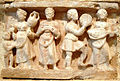
Wine-drinking and music, Hadda, 1st-2nd century CE.

A Corinthian capitol with a Buddha at its center, 2nd century, Surk Kotal, Afghanistan.
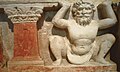
The Greek god Atlas, supporting a Buddhist monument, Hadda.

The Bodhisattva Maitreya, 2nd century, Gandhara.
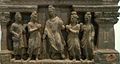
Scene of the life of the Buddha. 2nd-3rd century. Gandhara.
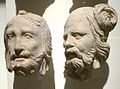
Portraits from the site of Hadda, 3rd century.
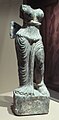
Statuette excavated from the Dharmarajika Stupa site at Sirkap, Pakistan.


Serindian art
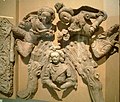
"Heroic gesture of the Bodhisattva", 6th-7th century terracotta, Tumshuq (Xinjiang).

Head of a Bodhisattva, 6th-7th century terracotta, Tumshuq (Xinjiang).

Chinese art
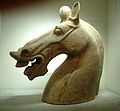
Han Dynasty Horse (1st-2nd century)

Buddha triad, Eastern Wei (534-550), China.

Tang Dynasty Foreign Merchant

Northern Qi depiction of Sogdians

One of the Group of glazed pottery luohans from Yixian, c 1000
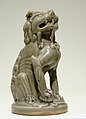
A sitting celadon lion, dated 11th to 12th century, Song Dynasty.

A porcelain vase with design of men fighting on horseback, from the Jiajing reign period (1521–1567), Ming Dynasty.

A round sancai dish from the Tang Dynasty, 8th to 9th century
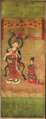
Painting Bodhisattva Who Leads the Way from Mo-kao caves, 900-950 A.D.


Indian art

An aniconic representation of Mara's assault on the Buddha, 2nd century, Amaravati, Guntur, India.
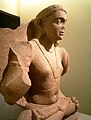
The Bodhisattva Maitreya, 2nd century, Mathura.

A Buddha, 2nd century, Mathura.

Buddha of the Gupta period, 5th century, Mathura.
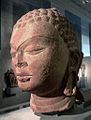
Head of a Buddha, Gupta period, 6th century.
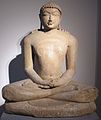
Rishabhanatha, sandstone, Madhya Pradesh, Chandela period, 10th-11th century

Buddha and Bodhisattvas, 11th century, Pala Empire.

Vishnu - a Hindu deity, Madhya Pradesh, 11th-12th century

Shiva from Tamil Nadu, Chola period, 11th century
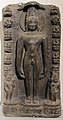
Rishabhanatha, 11th-12th century


Southeast Asian art
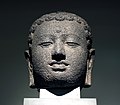
Head of Buddha taken from Borobudur, c. 8th-9th century Central Java, Indonesia

Agastya, c. 8th-9th century Central Java, Indonesia

Hindu deity Brahma, Cambodia

Brahma 10th century, Cambodia

Shiva from Vijayapura, Vietnam
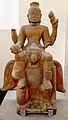
Vishnu on Garuda, Champa art, Vietnam

Ganesha, Siem Reap, Cambodia, c. 12th-13th century
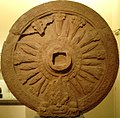
Mons Wheel of the Law (Dharmacakra), art of Dvaravati, c.8th century.
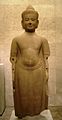
A Cambodian Buddha, 14th century
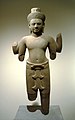
Bodhisattva Lokesvara, Cambodia 12th century.


See also
- List of museums in Paris
Notes
^ History of the Museum (in French).
^ National museum Arts asiatiques – Guimet, Marie-Catherine Rey et al. Paris: Éditions de la Réunion des Musées nationaux, 2001, translation by John Adamson, .mw-parser-output cite.citation{font-style:inherit}.mw-parser-output q{quotes:"""""""'""'"}.mw-parser-output code.cs1-code{color:inherit;background:inherit;border:inherit;padding:inherit}.mw-parser-output .cs1-lock-free a{background:url("//upload.wikimedia.org/wikipedia/commons/thumb/6/65/Lock-green.svg/9px-Lock-green.svg.png")no-repeat;background-position:right .1em center}.mw-parser-output .cs1-lock-limited a,.mw-parser-output .cs1-lock-registration a{background:url("//upload.wikimedia.org/wikipedia/commons/thumb/d/d6/Lock-gray-alt-2.svg/9px-Lock-gray-alt-2.svg.png")no-repeat;background-position:right .1em center}.mw-parser-output .cs1-lock-subscription a{background:url("//upload.wikimedia.org/wikipedia/commons/thumb/a/aa/Lock-red-alt-2.svg/9px-Lock-red-alt-2.svg.png")no-repeat;background-position:right .1em center}.mw-parser-output .cs1-subscription,.mw-parser-output .cs1-registration{color:#555}.mw-parser-output .cs1-subscription span,.mw-parser-output .cs1-registration span{border-bottom:1px dotted;cursor:help}.mw-parser-output .cs1-hidden-error{display:none;font-size:100%}.mw-parser-output .cs1-visible-error{font-size:100%}.mw-parser-output .cs1-subscription,.mw-parser-output .cs1-registration,.mw-parser-output .cs1-format{font-size:95%}.mw-parser-output .cs1-kern-left,.mw-parser-output .cs1-kern-wl-left{padding-left:0.2em}.mw-parser-output .cs1-kern-right,.mw-parser-output .cs1-kern-wl-right{padding-right:0.2em}
ISBN 2711838978, Chronology, p. 6.
^ Patrick Howlett-Martin, « Où ira le buste de Néfertiti ? », Le Monde diplomatique, no 700, juillet 2012, p. 27.
External links
 | Wikimedia Commons has media related to Musée Guimet. |
- Musée Guimet
Tourism in Paris | ||
|---|---|---|
| Landmarks |
|   |
| Museums |
| |
| Religious buildings |
| |
| Hôtels particuliers and palaces |
| |
| Bridges, streets, areas, squares and waterways |
| |
| Parks and gardens |
| |
| Sport venues |
| |
| Cemeteries |
| |
| Région parisienne |
| |
| Culture and events |
| |
| Other |
| |


Coordinates: 48°51′55″N 2°17′38″E / 48.86528°N 2.29389°E / 48.86528; 2.29389
Authority control  |
|
|---|


