Pacific Southwest Airlines
Pacific Southwest Airlines
Jump to navigation
Jump to search
 | |||||||
| Founded | 1949 | ||||||
|---|---|---|---|---|---|---|---|
| Commenced operations | 1949 | ||||||
| Ceased operations | 1988 (integrated into USAir) | ||||||
| Hubs |
| ||||||
| Fleet size | 75 | ||||||
| Destinations | 31 | ||||||
| Company slogan | Catch our Smile | ||||||
| Parent company | PSA Inc. (1949–1986) USAir (1987–1988) | ||||||
| Headquarters | San Diego, California | ||||||
| Key people | Kenny Friedkin (Founder and Original President) Jean Friedkin (Founder and Original Vice President) Eleanor Glithero (PSA's first employee) | ||||||
Pacific Southwest Airlines (PSA) was a United States airline headquartered in San Diego, California, that operated from 1949 to 1988. It was the first large discount airline in the United States. PSA called itself "The World's Friendliest Airline" and painted a smile on the nose of its airplanes, the PSA Grinningbirds. Opinion L.A. of the Los Angeles Times called PSA "practically the unofficial flag carrier airline of California for almost 40 years."[1]
The airline initially operated as an intrastate airline wholly within the state of California before expanding to other destinations in other western states in the U.S. following the Airline Deregulation Act of 1978 and also eventually operated international service to several destinations in Mexico.
In 1986, PSA became the first of two airlines that were bought, or merged, into the existing USAir, followed by Piedmont Airlines in 1987. The PSA acquisition was completed in 1988. USAir changed its name to US Airways in 1997. In 2005, after its second bankruptcy filing, America West Airlines acquired US Airways, continuing with the name until it merged with American Airlines in 2013.
In November 1995, the PSA name was given to Jetstream International Airlines, becoming PSA Airlines, so that US Airways could preserve the PSA name and trademarks. US Airways had acquired Jetstream International in 1987, when it was a subsidiary of Piedmont Airlines.
Contents
1 History
2 Corporate culture
3 Headquarters
4 Accidents and incidents
4.1 Hijackings
5 Destinations
6 Fleet
6.1 Final fleet
6.2 Historic fleet
6.3 PSA training fleet
7 References
8 External links
History[edit]

A Lockheed L-188 Electra of PSA in flight around 1959.

PSA 1953 logo

A PSA Boeing 737-200 with the “smiling” livery in 1974.
Kenny Friedkin founded the airline in 1949 with a $1,000-a-month leased Douglas DC-3. Friedkin obtained information from a travel agent upon starting the airline due to lessons learned from a failed precursor airline (Friedkin Airlines).[2] The DC-3 inaugurated a weekly round trip from San Diego to Oakland via Burbank. Reservations were initially taken from a World War II surplus latrine refitted as a ticket office. In 1951, PSA flights moved from Oakland to San Francisco International Airport. By 1953, the airline had returned to Oakland (OAK) and was continuing to serve San Francisco (SFO), Burbank (BUR) and San Diego (SAN) as well.[3] In 1955 PSA bought two Douglas DC-4s from Capital Airlines and painted boxes around the windows to make the planes resemble the Douglas DC-6.
In January 1958, it scheduled 37 DC-4s a week Burbank to San Francisco (29 of which originated in San Diego) and four nonstop flights San Diego to San Francisco; the fare from Burbank to San Francisco was $9.99. United Airlines, Western Airlines and TWA at that time were operating a combined total of 241 nonstop flights each week from Los Angeles to San Francisco with 49 flights a week being operated from Burbank to San Francisco. About half of these flights operated by the competition were First Class only ($22.05); the rest carried coach passengers for $13.50 (all fares operated by interstate air carriers were subject to 10% federal tax.) Later in 1958 PSA shifted some flights from Burbank to Los Angeles International Airport (LAX); that year it carried 296,000 passengers.
In late 1959 PSA began flying Lockheed L-188 Electra turboprops[4] configured with 92 seats and a six-seat lounge, replacing 70-seat DC-4s. Boeing 727-114s, Boeing 727-214s, Boeing 737-214s and McDonnell Douglas DC-9-30s replaced the Electras in 1966–70. The May 1965 OAG shows 103 Electras a week from Los Angeles (LAX) to San Francisco (SFO), 32 a week from Los Angeles to Oakland (OAK), 34 a week from Burbank (BUR) to San Francisco and 5 a week from San Diego (SAN) to San Francisco. En route flying time between Los Angeles and San Francisco was scheduled for 60 minutes while Burbank-San Francisco was 55 minutes. In 1966 PSA started flying to San Jose (SJC), and in 1967 to Sacramento Executive Airport (SAC); later that year PSA and other airlines moved to the new Sacramento International Airport (SMF). Ontario (ONT) was added in 1968 and Long Beach (LGB), Fresno (FAT) and Stockton (SCK) in 1971–72. Starting in 1974 PSA briefly operated several wide body Lockheed L-1011 TriStar jetliners until 1976 before deeming them unprofitable and parking them. PSA's L-1011-1s were unique in having lower deck seating.[5] The L-1011s flew intrastate routings of Los Angeles-San Francisco, Los Angeles-San Francisco-Sacramento and San Diego-Los Angeles-San Francisco. PSA was the only intrastate airline in the U.S. ever to operate wide body jetliners. Electras returned in 1975 for flights to Lake Tahoe (TVL) that ended in 1979. (Lake Tahoe, in the Sierra Nevada Mountains, did not allow airline jets until the 1980s although Pacific Air Lines briefly operated Boeing 727-100s into Lake Tahoe in 1966.) Major intrastate competitor Air California also flew Electras to Lake Tahoe until 1979–80 but then returned to Lake Tahoe as AirCal with McDonnell Douglas MD-80s and Boeing 737-300s after the jet ban ended. PSA never again served Lake Tahoe after retiring its Electras.
After airline deregulation, PSA expanded beyond California to Reno (RNO), Las Vegas (LAS), Salt Lake City (SLC), Phoenix (PHX), Tucson (TUS) and Albuquerque (ABQ). Its first flight beyond California was Oakland to Reno in December 1978. The airline introduced automated ticketing and check-in machines at several airports and briefly flew to Cabo San Lucas (SJD) in Mexico. When PSA's plan to buy the assets of Braniff International Airways fell through, the airline expanded its network north to Washington, Oregon and Idaho. PSA operated new British Aerospace BAe 146-200 jets to smaller airports like Eureka, California (ACV) and Concord, California (CCR). PSA held a "Name the Plane" contest, publicized in full-page newspaper advertisements, to name the fleet, with the prize being a private flight for the winner and 99 friends. The winning entry was Smiliner[6] submitted by Dr. Hugh Jordan of Whittier, California.[7]
Revenue Passenger-Miles/Kilometers, in millions
| Year | Traffic |
|---|---|
| 1964 | 490 RPMs |
| 1968 | 1232 RPMs |
| 1970 | 1585 RPMs |
| 1973 | 3116 RPKs |
| 1979 | 4527 RPKs |
| 1985 | 5670 RPKs |
In 1986 Western and AirCal were purchased (by Delta Air Lines and American Airlines respectively).
An hour after the AirCal deal was announced PSA agreed to merge with USAir, which was completed in 1987. At the time, PSA was in talks with Boeing about acquiring a Boeing 757-200, but never ordered it. PSA's last flight was on April 8, 1988. The PSA route network slowly disintegrated within USAir and was gone by 1994. Most of the former airline's assets were scrapped or moved to USAir's hubs on the East Coast. PSA's base at San Diego International Airport was gutted and served for a time as that airport's commuter terminal, before being renovated in administrative offices. PSA had planned to become a nationwide carrier, but this never came to fruition. By the time of the merger, PSA's route system covered the western United States as far east as Colorado and New Mexico, and as far north as Washington state.
In the San Diego Aerospace Museum a display showcases PSA, the city's home town airline.
PSA was one of the sponsors of The Dating Game TV show on ABC from 1965 to 1973.

US Airways Airbus A319 painted in PSA's livery
After the 2005 merger of US Airways and America West, a US Airways Airbus A319 was repainted in PSA's livery as one of four heritage aircraft commemorating the airlines that had merged to form the present-day US Airways. The aircraft was dedicated at San Diego International Airport's former commuter terminal (PSA's former operations base) on March 30, 2006, and flew routes similar to PSA's.
Corporate culture[edit]
PSA was known for its sense of humor. Founder Ken Friedkin wore Hawaiian shirts and encouraged his pilots and stewardesses to joke with passengers. Its slogan was "The World's Friendliest Airline", and its recognizable trademark was a smile painted on the nose of each plane and an accompanying advertising campaign declaring "Catch Our Smile".[8] Because of the major San Diego flight schedule and its discount fares, military personnel nicknamed PSA the "Poor Sailor's Airline."[9] After PSA was bought by USAir, ex-PSA mechanics would occasionally paint smiles on USAir planes as a joke.[10]

An example of the PSA smile on one of its Lockheed L-1011 TriStars.
During the 1960s, PSA was also known for the brightly colored flight attendant uniforms that included miniskirts. In the early 1970s, the fashion changed to hotpants.[9] One PSA flight attendant, Marilyn Tritt, wrote a book about her tenure at the company titled Long Legs and Short Nights (.mw-parser-output cite.citation{font-style:inherit}.mw-parser-output q{quotes:"""""""'""'"}.mw-parser-output code.cs1-code{color:inherit;background:inherit;border:inherit;padding:inherit}.mw-parser-output .cs1-lock-free a{background:url("//upload.wikimedia.org/wikipedia/commons/thumb/6/65/Lock-green.svg/9px-Lock-green.svg.png")no-repeat;background-position:right .1em center}.mw-parser-output .cs1-lock-limited a,.mw-parser-output .cs1-lock-registration a{background:url("//upload.wikimedia.org/wikipedia/commons/thumb/d/d6/Lock-gray-alt-2.svg/9px-Lock-gray-alt-2.svg.png")no-repeat;background-position:right .1em center}.mw-parser-output .cs1-lock-subscription a{background:url("//upload.wikimedia.org/wikipedia/commons/thumb/a/aa/Lock-red-alt-2.svg/9px-Lock-red-alt-2.svg.png")no-repeat;background-position:right .1em center}.mw-parser-output .cs1-subscription,.mw-parser-output .cs1-registration{color:#555}.mw-parser-output .cs1-subscription span,.mw-parser-output .cs1-registration span{border-bottom:1px dotted;cursor:help}.mw-parser-output .cs1-hidden-error{display:none;font-size:100%}.mw-parser-output .cs1-visible-error{font-size:100%}.mw-parser-output .cs1-subscription,.mw-parser-output .cs1-registration,.mw-parser-output .cs1-format{font-size:95%}.mw-parser-output .cs1-kern-left,.mw-parser-output .cs1-kern-wl-left{padding-left:0.2em}.mw-parser-output .cs1-kern-right,.mw-parser-output .cs1-kern-wl-right{padding-right:0.2em}ISBN 0-9649577-0-1).
Management diversified in the early 1970s into a broadcasting venture called PSA Broadcasting. Radio stations were purchased in Sacramento (96.9 KPSC later KEZC), San Jose (106.5 KEZD later KEZR), Los Angeles (107.5 KPSA later KLVE) and San Diego (102.9 KEZL now KLQV). All ran easy listening formats (hence EZ call letter combinations). The idea was to keep some of the airline's advertising dollars within the broadcasting company as well as collect some co-op (co-operative advertising) from businesses doing business with the airline. These stations were sold to various interests in the late 1970s.
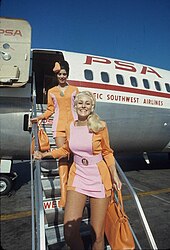
PSA flight attendants disembarking from one of the company's aircraft.
Throughout PSA's lifetime as an airline, the flight attendants, with their humor, over-the-top passenger service, and sense of duty, helped to create a loyal passenger following. One flight attendant, Sandy Daniels, with the help of a frequent flyer, started the "Precious Stewardess Association". Frequent fliers would bring tasty treats to the crew, particularly on morning flights. In turn, PSA started the "Precious Passenger Association", with certificates and free drinks given to friendly and helpful passengers.
Ken Friedkin's son Tom was a PSA pilot in 1962 when the elder Friedkin died abruptly of a stroke, aged 47. A year later, Tom Friedkin's mother died, making him the largest shareholder of PSA. Tom had a seat on the Board of Directors, but continued working as a full-time pilot for the airline.[9]
Southwest Airlines founder Herb Kelleher studied PSA extensively and used many of the airline's ideas to form the corporate culture at Southwest, and even on early flights used the same "Long Legs And Short Nights" theme for stewardesses on board typical Southwest Airlines flights.
PSA helped train the first class of mechanics for Southwest Airlines and lent the fledgling carrier flight manuals and other needed items.
Headquarters[edit]
The PSA headquarters were located in a windowless gray-brown building on Harbor Drive in San Diego, California.[11][12] The building was San Diego International Airport's commuter terminal until 2015 when it was converted into administrative offices of the San Diego County Regional Airport Authority.
Accidents and incidents[edit]
- On January 15, 1969, a PSA Boeing 727-100 collided with Cessna 182 N42242 while it was climbing to its cruising altitude. Both aircraft were in controlled airspace on the same frequency. The 727 continued on to Ontario and made a safe landing. The right wing of the Cessna was damaged, so it returned to San Francisco.[13]
- On March 5, 1974, a PSA NAMC YS-11 training aircraft's engines failed, resulting in the aircraft crashing in the desert near Borrego Springs, California. The turboprop aircraft was doing a simulated landing stall. All of the four crew members survived the crash. The aircraft was written off.[14]
- On September 25, 1978, PSA Flight 182, a Boeing 727-200, crashed in San Diego while trying to land at Lindbergh Field (San Diego International Airport), California, after colliding with a Cessna 172 operated by Gibbs Flite Center. The 727 crashed at the intersection of Dwight and Nile. The Cessna fell a few blocks away. All 135 persons aboard the PSA flight were killed, as were the two people in the Cessna and seven on the ground. At the time, it was the deadliest plane crash in U.S. history; it is still the worst mid-air collision in the United States.[15] A lawsuit argued by Gary Aguirre resulted in a verdict against PSA for damages.[16]
- On December 7, 1987, PSA Flight 1771, a BAe 146, bound for San Francisco International Airport from Los Angeles International Airport, was airborne above the central coast of California when it suddenly entered a high-speed nosedive and crashed on a cattle ranch near the small coastal town of Cayucos in San Luis Obispo County. Investigations determined that David Burke, a former employee of USAir (which had recently acquired PSA) who had been fired for theft, had armed himself and boarded the flight, which was carrying his former manager. After writing a note on an air sickness bag, Burke then shot his ex-manager, a flight attendant, both pilots and possibly the airline's chief pilot. After shooting the pilots, Burke pushed down on the control column, causing it to enter a dive. All 43 aboard the jetliner, including 38 passengers and 5 crew members, died.[17]
Hijackings[edit]
There were several attempted hijackings which resulted in no injuries and the surrender of the often lone hijacker. These incidents are not included. The following are notable hijackings because of fatalities or success in forcing the aircraft to fly to another country
- On January 7, 1972, PSA 902, a Boeing 727-200 flight from San Francisco to Los Angeles was hijacked to Cuba. The captain negotiated the release of the passengers in Los Angeles and the hijackers, armed with a shotgun and other arms, were taken to Cuba[18] with a fueling stop in Tampa where they released custody of the aircraft back to the captain. Three flight attendants and three off-duty flight attendants were not released with the passengers and accompanied the flight to Cuba.[19]
- On July 5, 1972, PSA Flight 710, a Boeing 737-200 flight from Sacramento to San Francisco was hijacked with demands to fly to the Soviet Union. The plane was stormed while on the ground at San Francisco, resulting in the deaths of one passenger and the two hijackers.[20] One of the passengers, who survived being shot in the back, was the actor Victor Sen Yung, best known as Hop Sing from the Bonanza television series. One other passenger was shot and survived.[21][22]
- On May 1, 1980, PSA Flight 818, a Boeing 727 flying from Stockton to Los Angeles with eight people on board, was hijacked. The hijacker demanded to be taken to Iran, but was overpowered by Alan Romatowski, the pilot left on board the aircraft.[23]
Destinations[edit]

Passengers board a PSA Boeing 727 in rainy weather in 1971.
PSA served many destinations in the western U.S. and Mexico over the years although not all at the same time. The following is a list of known PSA destinations served during the airline's existence.[24][25]
Arcata-Eureka Airport, Arcata/Eureka (ACV)
Burbank-Glendale-Pasadena Airport, Burbank (BUR)
Buchanan Field Airport, Concord (CCR)
Fresno Air Terminal, Fresno (FAT)
Lake Tahoe Airport, South Lake Tahoe (TVL)
Long Beach Airport, Long Beach (LGB)
Los Angeles International Airport, Los Angeles (LAX)
Monterey Peninsula Airport, Monterey (MRY)
Oakland International Airport, Oakland (OAK)
Ontario International Airport, Ontario (ONT)
Palm Springs International Airport, Palm Springs (PSP)
Sacramento Municipal Airport (SAC) – (all airline service was moved to the then-new SMF in October 1967 and this airfield was renamed Sacramento Executive Airport)
Sacramento Metropolitan Airport, Sacramento (SMF)
San Diego International Airport, San Diego (SAN) – Home Base
San Francisco International Airport, San Francisco (SFO)
San Jose International Airport, San Jose (SJC)
John Wayne Airport, Santa Ana (SNA)
Stockton Metropolitan Airport, Stockton (SCK)
Arizona
Phoenix Sky Harbor International Airport, Phoenix (PHX)
Tucson International Airport, Tucson (TUS)
Colorado
Yampa Valley Airport, Steamboat Springs (HDN)
Idaho
Boise International Airport, Boise (BOI)
New Mexico
Albuquerque International Sunport, Albuquerque (ABQ)
Nevada
McCarran International Airport, Las Vegas (LAS)
Reno-Tahoe International Airport, Reno (RNO)
Indonesia
Hang Nadim International Airport,Raja Haji Fisabilillah International Airport
Utah
Salt Lake City International Airport, Salt Lake City (SLC)
Fleet[edit]
Final fleet[edit]
PSA fleet details at the time of its merger into USAir:
| Aircraft | Total | Passengers |
|---|---|---|
McDonnell Douglas DC-9-31 | 3 | 107 |
McDonnell Douglas DC-9-32 | 1 | 107 |
British Aerospace BAe 146-200 | 24 | 85 |
British Aerospace BAe 146-100 | 1 | |
McDonnell Douglas MD-81 | 23 | 150 |
McDonnell Douglas MD-82 | 12 | 150 |
Historic fleet[edit]
Historic PSA fleet:
| 1940s | 1950s | 1960s | 1970s | 1980s | ||||||||||||||||||||||||||||||||||
Douglas DC-3/C-47 Skytrain 1949–1955 | ||||||||||||||||||||||||||||||||||||||
Douglas DC-4/C-54 Skymaster 1954–1959 | McDonnell Douglas MD-80 1980–1988 | |||||||||||||||||||||||||||||||||||||
Lockheed L-188 Electra 1958–1969 | Lockheed TriStar 1974–1975 | Lockheed L-188 Electra 1975–1979 | BAe-146 1984–1988 | |||||||||||||||||||||||||||||||||||
DC-6 1960–1961 | Boeing 727 1964–1985 (includes series -100 and -200 aircraft) | |||||||||||||||||||||||||||||||||||||
Boeing 737-200 1968–1976 | ||||||||||||||||||||||||||||||||||||||
McDonnell Douglas DC-9-30 1967–1969 | McDonnell Douglas DC-9-30 1983–1988 | |||||||||||||||||||||||||||||||||||||
- PSA continued to operate the DC-4/C-54 aircraft for charter flights until 1961.
- The L-1011 "Mother Grinningbirds" which PSA had removed from scheduled service were leased to other airlines and companies until they were sold in 1985 to Worldways Canada.
- PSA operated a single DC-6B between 1960 and 1961 to Oakland, California, while awaiting the delivery of an Electra to take its place.

A PSA Lockheed L-1011 TriStar before delivery.
Historic PSA fleet details:
| Aircraft | Total | Passengers | PSA name |
|---|---|---|---|
Douglas DC-3/C-47 Skytrain | 9 | ||
Douglas DC-4/C-54 Skymaster | 4 | ||
Lockheed L-188 Electra | 9 | Super Electra Jet/Electrode/Trode | |
Douglas DC-6B | 1 | ||
Boeing 727-14 | 9 | ||
| Boeing 727-114 | 1 | ||
| Boeing 727-173C | 2 | ||
| Boeing 727-51 | 5 | ||
| Boeing 727-81 | 1 | ||
| Boeing 727-214 | 18 | ||
| Boeing 727-2J7A | 2 | ||
| Boeing 727-214A | 7 | ||
| Boeing 727-254 | 5 | ||
| Boeing 727-2QA | 1 | ||
Bell 206 | 1 | ||
Boeing 737-214 | 12 | Fat Albert or FA | |
| Boeing 737-293 | 2 | Fat Albert or FA | |
McDonnell Douglas DC-9-31 | 4 | 107 | |
| McDonnell Douglas DC-9-32 | 2 | 107 | |
Lockheed L-1011-1 TriStar | 2 | Mother Grinningbird | |
McDonnell Douglas MD-81 | 21 | 156-150 | |
| McDonnell Douglas MD-82 | 17 | 156-150 | |
BAe 146-100 | 1 | Smiliner | |
| BAe 146-100A | 2 | Smiliner | |
| BAe 146-200 | 5 | 100-85 | Smiliner |
| BAe 146-200A | 19 | 100-85 | Smiliner |
PSA training fleet[edit]
The following aircraft were used for training only.
List of aircraft PSA used for training:[26]
Pacific Southwest Airlines training aircraft fleet | |
| Aircraft | Total |
|---|---|
Piper Aztec 28R-180 | 1 |
Bell 47-G4A | 1 |
Beech Bonanza F33-A | 7 |
Piper Aztec 23-350 | 9 |
Piper Comanche 24-260 | 5 |
Learjet 24 | 1 |
Piper Aztec 23-250 | 5 |
NAMC YS-11A-202 | 1 |
NAMC YS-11A-212 | 1 |
Brantly B-2 | 1 |
Beech 99 | 1 |
References[edit]
^ "Southwest Airlines has a flashback – emphasis flash." Los Angeles Times. March 3, 2009. Retrieved on February 18, 2010.
^ ;Trinkle, Kevin, PSA History Archived 2008-12-19 at the Wayback Machine.. Retrieved June 2, 2011
^ http://www.timetableimages.com, June 3, 1953 PSA system timetable
^ Airlift December 1959
^ The PSA History/Olditimers Page – Lockheed L-1011 – Trinkle, Kevin; Retrieved August 24, 2010, Archived December 19, 2008, at the Wayback Machine.
^ Smiliner Archived 2007-01-02 at the Wayback Machine.
^ http://www.oldenglishsheepdogclubofamerica.org/hugh_e_jordan.php Dr. Hugh Jordan OESCA Memorial Page
^ "PSA's Spring SuperSmile fares..." Spokane Chronicle. advertisement. March 24, 1987. p. A9.
^ abc Forbes Magazine: October 1, 2001-Under the Radar by Doug Donovan
^ Trinkle, Kevin. "Smiles on US Airways". The PSA History Page. Retrieved January 7, 2014.
^ Ray, Nancy. "CORPORATE 'FAMILY' MOURNS." Los Angeles Times. September 27, 1978. Start Page SD_A9. Retrieved on February 18, 2010.
^ "World Airline Directory." Flight International. March 31, 1984. 876.
^ http://aviation-safety.net/database/record.php?id=19690115-1
^ ASN accident NAMC YS-11A-202 N208PA Borrego Springs, California Retrieved April 8, 2008
^ ASN accident Boeing 727-214 N533PS San Diego International Airport, CA (SAN) Retrieved April 1, 2009
^ Ted Vollmer, "PSA Ruled Liable for Crash Damage Claims", Los Angeles Times San Diego County edition (August 15, 1979)
^ ASN aircraft accident British Aerospace BAe-146-200 N350PS Paso Robles, CA
^ ASN Aircraft accident Boeing 727 ?
^ Airliner Magazine, November, 2000
^ ASN Aircraft accident Boeing 737-200 San Francisco International Airport, CA (SFO)
^ Ada Evening News, July 6, 1972, p. 1
^ Emch, Tom (September 12, 2009). "Anatomy of a Hijack". SF Chronicle and Examiner. Retrieved 1 April 2013.
^ http://aviation-safety.net/database/record.php?id=19800501-0
^ The PSA/Oldtimers Page
^ PSA Pacific Southwest Airlines bag tags
^ Trinkle, Kevin. "Flight Training" Archived 2012-05-19 at the Wayback Machine. – The PSA History/Olditimers Page – Retrieved March 28, 2009
External links[edit]
 Media related to Pacific Southwest Airlines at Wikimedia Commons
The PSA History Museum – Dedicated to preserving the history of PSA
PSA-history.org – history of PSA- Poor sailors' airline: A history of Pacific Southwest Airlines
 Media related to Pacific Southwest Airlines at Wikimedia Commons
American Airlines | |||||
|---|---|---|---|---|---|
Oneworld member | |||||
| Mergers and acquisitions |
| ||||
| Facilities |
| ||||
| Programs |
| ||||
| Brands |
| ||||
| Incidents |
| ||||
| People |
| ||||
| Organizations |
| ||||
| Related |
| ||||
| |||||
 Category
 Portal


Categories:
- Pacific Southwest Airlines
- Airlines established in 1949
- Airlines disestablished in 1988
- Companies based in San Diego
- Defunct companies based in California
- Defunct airlines of the United States
- US Airways Group
- 1949 establishments in California
- American companies established in 1949


(window.RLQ=window.RLQ||).push(function(){mw.config.set({"wgPageParseReport":{"limitreport":{"cputime":"0.412","walltime":"0.573","ppvisitednodes":{"value":1661,"limit":1000000},"ppgeneratednodes":{"value":0,"limit":1500000},"postexpandincludesize":{"value":59237,"limit":2097152},"templateargumentsize":{"value":1552,"limit":2097152},"expansiondepth":{"value":12,"limit":40},"expensivefunctioncount":{"value":0,"limit":500},"unstrip-depth":{"value":1,"limit":20},"unstrip-size":{"value":19429,"limit":5000000},"entityaccesscount":{"value":1,"limit":400},"timingprofile":["100.00% 373.757 1 -total"," 26.24% 98.064 1 Template:Reflist"," 15.84% 59.203 1 Template:ISBN"," 12.66% 47.304 1 Template:Infobox_airline"," 12.04% 44.987 1 Template:Cite_news"," 11.80% 44.104 1 Template:About"," 10.07% 37.632 1 Template:Catalog_lookup_link"," 9.45% 35.328 1 Template:Infobox"," 8.79% 32.858 3 Template:Navbox"," 6.41% 23.969 1 Template:Commons_category-inline"]},"scribunto":{"limitreport-timeusage":{"value":"0.090","limit":"10.000"},"limitreport-memusage":{"value":4175216,"limit":52428800}},"cachereport":{"origin":"mw1249","timestamp":"20181108223516","ttl":1900800,"transientcontent":false}}});mw.config.set({"wgBackendResponseTime":114,"wgHostname":"mw1266"});});


