NML Cygni
NML Cygni
Jump to navigation
Jump to search
Coordinates:  20h 46m 25.54s, +40° 06′ 59.40″
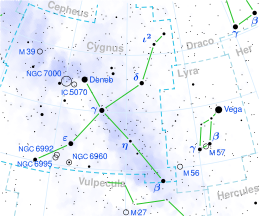  | |
| Observation data Epoch J2000 Equinox J2000 | |
|---|---|
Constellation | Cygnus |
Right ascension | 20h 46m 25.54s[1] |
Declination | +40° 06′ 59.4″[1] |
Apparent magnitude (V) | 16.60 (variable)[2] |
| Characteristics | |
Spectral type | M4.5-M7.9Ia-III[3] |
Apparent magnitude (K) | 12.3[4] |
| B−V color index | +2.04[2] |
Variable type | SR[5] |
| Astrometry | |
| Proper motion (μ) | RA: −1.55[6] mas/yr Dec.: −4.59[6] mas/yr |
| Parallax (π) | 0.620 ± 0.047[6] mas |
| Distance | 7003525000000000000♠5,250+420 −360 ly (7003161000000000000♠1,610+130 −110[6] pc) |
| Details | |
| Mass | 50[7] M☉ |
| Radius | 1,183[4](1,640[a]-2,770[b])[6] R☉ |
| Luminosity | 7005272000000000000♠272,000±50,000[4][6] L☉ |
| Temperature | 3,834[4](2,500-3,250)[6] K |
| Age | 8[6] Myr |
| Other designations | |
V1489 Cyg, RAFGL 2650, IRC+40448, 2MASS J20462554+4006594, AAVSO 2042+39 | |
| Database references | |
| SIMBAD | data |
NML Cygni or V1489 Cygni is a red hypergiant (RHG)[6] or red supergiant (RSG) in the constellation Cygnus. It is one of the largest stars currently known, and is also one of the most luminous and massive cool hypergiants, as well as one of the most luminous stars in the Milky Way. If placed at the center of the Solar System, its surface would extend past the orbit of Jupiter or Saturn.
The distance of NML Cygni from Earth is estimated to be around 1.6 kpc, about 5,300 light-years.[8] It is a part of the Cygnus OB2 association, one of the closest massive associations to the Sun, spanning nearly 2° on the sky or ∼30 pc in radius at the distance of 7019536907899175291♠1.74±0.2 kpc.[9]
Contents
1 Observational history
2 Characteristics
3 References
4 Notes
Observational history[edit]

NML Cygni was discovered in 1965 by Neugebauer, Martz, and Leighton who described two extremely red luminous stars, their colour being consistent with a black body temperature of 1,000 K.[10] The name NML comes from the names of these three discoverers.[11] The second star was briefly referred to as NML Tauri[12] but is now known as IK Tauri,[13] an M9 Mira variable. NML Cygni has since also been given the designation V1489 Cygni on account of the small semi-regular brightness variations,[14] but is still most commonly referred to as NML Cygni. Its composition began to be revealed with the discovery of OH masers (1612 MHz) in 1968.[15]H
2O, SiO, CO, HCN, CS, SO, SO
2, and H
2S molecules have also been detected.[16]
Characteristics[edit]
NML Cygni is a very large and luminous cool supergiant and is also a semiregular variable star with a period of either 1,280 or 940 days.[3][9] It occupies the upper-right hand corner of the Hertzsprung–Russell diagram.
The bolometric luminosity (Lbol) for NML Cygni was originally calculated to be 500,000 L☉ at an assumed distance of 7019617135516293438♠2 kpc and the radius was calculated to be 3,740 R☉ based on an 6992416939765754201♠8.6 mas angular diameter and distance.[17][c][18][19] More modern and accurate measurements give a radio angular diameter of 44 mas at a distance of 7019493708413034750♠1.6 kpc, which gives a luminosity around 300,000 L☉, suggesting the optical angular diameter may be around 22 mas.[6] This distance and luminosity were combined with assumptions of the effective temperature of the star, giving a radius of 1,640 R☉[a] for a temperature of 3,250 K or possibly 2,770 R☉[b] for a temperature of 2,500 K.[6] However, the radius has recently been calculated to be 1,183 R☉ based on an assumed effective temperature of 3,834 K.[4] A 2006 study, similar to those conducted on VY Canis Majoris, think that NML Cygni is a normal red supergiant with consequently much lower luminosity and radius values.[20]
NML Cygni lies close to the expected position that a 25 M☉ star would evolve to after eight million years.[6] Estimates of its current mass are difficult. One published measure is 50 M☉.[7]
NML Cygni is evolved and a number of heavy elements and molecules have been detected in its atmosphere, particularly oxygen, hydroxyl, and water. It is surrounded by dusty material[6][9] and it exhibits a bean-shaped asymmetric nebula that is coincident with the distribution of its H2O vapor masers.[21]
NML Cygni has an estimated mass loss rate of 2×10⁻⁴ M☉ per year,[16] one of the highest known for any star. The annual parallax of NML Cygni is measured to be around 0.62 milliarcseconds.[6] From the observations, it is estimated that NML Cygni has two discrete optically thick envelopes of dust and molecules. The optical depth of the inner shell is found to be 1.9, whereas that of the outer one is 0.33.[22] These dust envelopes are formed due to the strong post-main-sequence wind, which has a velocity 23 km/s.[9]
Because of the star's position on the outskirts of the massive Cygnus OB2 association, the detectable effects of NML Cygni's radiation on the surrounding dust and gas are limited to the region away from the central hot stars of the association.[9]
References[edit]
^ ab Cutri, R. M.; Skrutskie, M. F.; Van Dyk, S.; Beichman, C. A.; Carpenter, J. M.; Chester, T.; Cambresy, L.; Evans, T.; Fowler, J.; Gizis, J.; Howard, E.; Huchra, J.; Jarrett, T.; Kopan, E. L.; Kirkpatrick, J. D.; Light, R. M.; Marsh, K. A.; McCallon, H.; Schneider, S.; Stiening, R.; Sykes, M.; Weinberg, M.; Wheaton, W. A.; Wheelock, S.; Zacarias, N. (2003). "VizieR Online Data Catalog: 2MASS All-Sky Catalog of Point Sources (Cutri+ 2003)". VizieR On-line Data Catalog: II/246. Originally Published In: 2003yCat.2246....0C. 2246: II/246. Bibcode:2003yCat.2246....0C..mw-parser-output cite.citation{font-style:inherit}.mw-parser-output q{quotes:"""""""'""'"}.mw-parser-output code.cs1-code{color:inherit;background:inherit;border:inherit;padding:inherit}.mw-parser-output .cs1-lock-free a{background:url("//upload.wikimedia.org/wikipedia/commons/thumb/6/65/Lock-green.svg/9px-Lock-green.svg.png")no-repeat;background-position:right .1em center}.mw-parser-output .cs1-lock-limited a,.mw-parser-output .cs1-lock-registration a{background:url("//upload.wikimedia.org/wikipedia/commons/thumb/d/d6/Lock-gray-alt-2.svg/9px-Lock-gray-alt-2.svg.png")no-repeat;background-position:right .1em center}.mw-parser-output .cs1-lock-subscription a{background:url("//upload.wikimedia.org/wikipedia/commons/thumb/a/aa/Lock-red-alt-2.svg/9px-Lock-red-alt-2.svg.png")no-repeat;background-position:right .1em center}.mw-parser-output .cs1-subscription,.mw-parser-output .cs1-registration{color:#555}.mw-parser-output .cs1-subscription span,.mw-parser-output .cs1-registration span{border-bottom:1px dotted;cursor:help}.mw-parser-output .cs1-hidden-error{display:none;font-size:100%}.mw-parser-output .cs1-visible-error{font-size:100%}.mw-parser-output .cs1-subscription,.mw-parser-output .cs1-registration,.mw-parser-output .cs1-format{font-size:95%}.mw-parser-output .cs1-kern-left,.mw-parser-output .cs1-kern-wl-left{padding-left:0.2em}.mw-parser-output .cs1-kern-right,.mw-parser-output .cs1-kern-wl-right{padding-right:0.2em}
^ ab Johnson, Harold L.; Mendoza v., Eugenio E.; Wisniewski, Weislaw Z. (1965). "Observations of "Infrared Stars."". Astrophysical Journal. 142: 1249. Bibcode:1965ApJ...142.1249J. doi:10.1086/148393.
^ ab "GCVS Query=V1489 Cyg". General Catalogue of Variable Stars @ Sternberg Astronomical Institute, Moscow, Russia. Retrieved 2018-09-21.
^ abcde De Beck, E.; Decin, L.; De Koter, A.; Justtanont, K.; Verhoelst, T.; Kemper, F.; Menten, K. M. (2010). "Probing the mass-loss history of AGB and red supergiant stars from CO rotational line profiles. II. CO line survey of evolved stars: Derivation of mass-loss rate formulae". Astronomy and Astrophysics. 523: A18. arXiv:1008.1083. Bibcode:2010A&A...523A..18D. doi:10.1051/0004-6361/200913771.
^ Blöcker, T.; Balega, Y.; Hofmann, K.-H.; Weigelt, G. (2001). "Bispectrum speckle interferometry observations and radiative transfer modelling of the red supergiant NML Cyg. Multiple dust-shell structures evidencing previous superwind phases". Astronomy and Astrophysics. 369: 142–154. arXiv:astro-ph/0102092. Bibcode:2001A&A...369..142B. doi:10.1051/0004-6361:20010095.
^ abcdefghijklmn Zhang, B.; Reid, M. J.; Menten, K. M.; Zheng, X. W.; Brunthaler, A. (2012). "The distance and size of the red hypergiant NML Cygni from VLBA and VLA astrometry" (PDF). Astronomy & Astrophysics. 544: A42. arXiv:1207.1850. Bibcode:2012A&A...544A..42Z. doi:10.1051/0004-6361/201219587.
^ ab Morris, M.; Jura, M. (1983). "The nature of NML Cygnus". Astrophysical Journal. 267: 179. Bibcode:1983ApJ...267..179M. doi:10.1086/160856.
^ Schuster, Michael Thomas (2007). Investigating the Circumstellar Environments of the Cool Hypergiants. ProQuest. p. 57. ISBN 978-0-549-32782-0. Retrieved 27 August 2012.
^ abcde Schuster, M. T.; Marengo, M.; Hora, J. L.; Fazio, G. G.; Humphreys, R. M.; Gehrz, R. D.; Hinz, P. M.; Kenworthy, M. A.; Hoffmann, W. F. (2009). "Imaging the Cool Hypergiant NML Cygni's Dusty Circumstellar Envelope with Adaptive Optics". The Astrophysical Journal. 699 (2): 1423–1432. arXiv:0904.4690. Bibcode:2009ApJ...699.1423S. doi:10.1088/0004-637X/699/2/1423.
^ Neugebauer, G.; Martz, D. E.; Leighton, R. B. (July 1965). "Observations of Extremely Cool Stars". Astrophysical Journal. 142: 399–401. Bibcode:1965ApJ...142..399N. doi:10.1086/148300.
^ Hearnshaw, J. B. (2 May 1996). "New infrared sources and their interpretation". The Measurement of Starlight: Two Centuries of Astronomical Photometry. Cambridge University Press. p. 278. ISBN 978-0-521-40393-1. Retrieved 23 August 2012.
^ Pesch, P. (1967). "Objective-Prism Spectra of Some Very Red Stars". The Astrophysical Journal. 147: 381. Bibcode:1967ApJ...147..381P. doi:10.1086/149015.
^ Kukarkin, B. V.; Efremov, Yu. N.; Frolov, M. S.; Medvedeva, G. I.; et al. (8 November 1968). "Identification List of the New Variable Stars Nominated in 1968". Information Bulletin on Variable Stars. 311 (1): 1. Bibcode:1968IBVS..311....1K.
^ Kukarkin, B. V.; Kholopov, P. N.; Kukarkina, N. P. (27 November 1975). "61st Name-List of Variable Stars". Information Bulletin on Variable Stars. 1068 (1): 1. Bibcode:1975IBVS.1068....1K.
^ Cohen, R. J.; Downs, G.; Emerson, R.; Grimm, M.; et al. (1 April 1987). "Narrow polarized components in the OH 1612-MHz maser emission from supergiant OH-IR sources". Monthly Notices of the Royal Astronomical Society. 225 (3): 491–498. Bibcode:1987MNRAS.225..491C. doi:10.1093/mnras/225.3.491.
^ ab Kevin Marvel (19 December 1996). "NML Cygni". The Circumstellar Environment of Evolved Stars As Revealed by Studies of Circumstellar Water Masers. Universal-Publishers. pp. 182–212. ISBN 978-1-58112-061-5. Retrieved 23 August 2012.
^ Zubko, Viktor; Li, Di; Lim, Tanya; Feuchtgruber, Helmut; Harwit, Martin (2004). "Observations of Water Vapor Outflow from NML Cygnus". The Astrophysical Journal. 610 (1): 427. arXiv:astro-ph/0405044. Bibcode:2004ApJ...610..427Z. doi:10.1086/421700.
^ Monnier, J. D; Bester, M; Danchi, W. C; Johnson, M. A; Lipman, E. A; Townes, C. H; Tuthill, P. G; Geballe, T. R; Nishimoto, D; Kervin, P. W (1997). "Nonuniform Dust Outflow Observed around Infrared Object NML Cygni". The Astrophysical Journal. 481 (1): 420. arXiv:astro-ph/9702103. Bibcode:1997ApJ...481..420M. doi:10.1086/304050.
^ Monnier, J. D.; Millan‐Gabet, R.; Tuthill, P. G.; Traub, W. A.; Carleton, N. P.; Coude Du Foresto, V.; Danchi, W. C.; Lacasse, M. G.; Morel, S.; Perrin, G.; Porro, I. L.; Schloerb, F. P.; Townes, C. H. (2004). "High‐Resolution Imaging of Dust Shells by Using Keck Aperture Masking and the IOTA Interferometer". The Astrophysical Journal. 605 (1): 436–461. arXiv:astro-ph/0401363. Bibcode:2004ApJ...605..436M. doi:10.1086/382218.
^ Massey, Philip; Levesque, Emily M.; Plez, Bertrand (1 August 2006). "Bringing VY Canis Majoris down to size: an improved determination of its effective temperature". The Astrophysical Journal. 646 (2): 1203–1208. arXiv:astro-ph/0604253. Bibcode:2006ApJ...646.1203M. doi:10.1086/505025.
^ Schuster, M. T.; Humphreys, R. M.; Marengo, M. (2006). "The Circumstellar Environments of NML Cygni and the Cool Hypergiants". The Astronomical Journal. 131 (1): 603–611. arXiv:astro-ph/0510010. Bibcode:2006AJ....131..603S. doi:10.1086/498395.
^ DanchiI, W. C.; Green, W. H.; Hale, D. D. S.; McEleroy, K.; et al. (July 2001). "Proper Motions of Dust Shells Surrounding NML Cygni". The Astrophysical Journal. 555 (1): 405. Bibcode:2001ApJ...555..405D. doi:10.1086/322237.
Notes[edit]
^ ab NML Cygni would be this size when applying the Stefan-Boltzmann Law with a nominal solar effective temperature of 5,772 K: (5772/3250)4∗270,000=1638.96 R⊙{displaystyle {sqrt {(5772/3250)^{4}*270,000}}=1638.96 Rodot }
^ ab Applying the Stefan-Boltzmann Law with a nominal solar effective temperature of 5,772 K: (5772/2500)4∗270,000=2769.84 R⊙{displaystyle {sqrt {(5772/2500)^{4}*270,000}}=2769.84 Rodot }
^ 7012260000000000000♠2.6×1014 cm and a solar radius of 7008695000000000000♠6.95×10⁵ km


Categories:
- M-type hypergiants
- Cygnus (constellation)
- Semiregular variable stars
- Astronomical objects discovered in 1965
- Objects with variable star designations
- 2MASS objects


(window.RLQ=window.RLQ||).push(function(){mw.config.set({"wgPageParseReport":{"limitreport":{"cputime":"0.776","walltime":"0.907","ppvisitednodes":{"value":4422,"limit":1000000},"ppgeneratednodes":{"value":0,"limit":1500000},"postexpandincludesize":{"value":181454,"limit":2097152},"templateargumentsize":{"value":11280,"limit":2097152},"expansiondepth":{"value":15,"limit":40},"expensivefunctioncount":{"value":3,"limit":500},"unstrip-depth":{"value":1,"limit":20},"unstrip-size":{"value":75309,"limit":5000000},"entityaccesscount":{"value":3,"limit":400},"timingprofile":["100.00% 601.412 1 -total"," 54.33% 326.767 2 Template:Reflist"," 40.12% 241.273 18 Template:Cite_journal"," 9.02% 54.258 1 Template:Starbox_image"," 8.75% 52.643 9 Template:Val"," 8.13% 48.892 1 Template:Starbox_astrometry"," 8.10% 48.686 1 Template:Location_mark"," 7.75% 46.590 1 Template:Location_mark+"," 6.12% 36.796 11 Template:Ifempty"," 5.40% 32.462 5 Template:Navbox"]},"scribunto":{"limitreport-timeusage":{"value":"0.300","limit":"10.000"},"limitreport-memusage":{"value":7372038,"limit":52428800}},"cachereport":{"origin":"mw1234","timestamp":"20181019230323","ttl":1900800,"transientcontent":false}}});mw.config.set({"wgBackendResponseTime":89,"wgHostname":"mw1319"});});


