Aeclanum
| Eclano | |
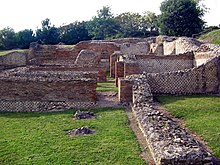 View of the thermae with the opus reticulatum brickwork | |
  Shown within Italy | |
| Location | Mirabella Eclano (Province of Avellino, Italy) |
|---|---|
| Region | Campania |
| Coordinates | 41°3′14″N 15°0′40″E / 41.05389°N 15.01111°E / 41.05389; 15.01111Coordinates: 41°3′14″N 15°0′40″E / 41.05389°N 15.01111°E / 41.05389; 15.01111 |
| Type | Settlement |
| History | |
| Periods | Roman Republic – Byzantine Empire |
| Cultures | Samnites – Ancient Rome |
| Site notes | |
| Archaeologists | Italo Sgobbo |
| Management | Soprintendenza per i Beni Archeologici di Salerno, Avellino, Benevento e Caserta |
| Public access | Yes |
| Website | Aeclanum |
Aeclanum (also spelled Aeculanum, Italian: Eclano, Ancient Greek: Ἀικούλανον)[1] was an ancient town of Samnium, southern Italy, about 25 km east-southeast of Beneventum, on the Via Appia. It lies in Passo di Mirabella, near the modern Mirabella Eclano.
Contents
1 Location
2 History
3 Bishopric
4 Gallery
5 References
6 External links
Location

View of the town
Aeclanum was on a promontory naturally defended, to some extent, by a steep slope on the south side down to the river Calore, while the north side lay open towards the crest of the ridge that carried what under the Roman Empire became the Via Appia. This led through Lacus Ampsanctus to Aquilonia and Venusia. Another route to Apulia, the Via Aurelia Aeclanensis diverged here, leading through modern Ariano to Herdoniae. The road from Aeclanum to Abellinum (mod. Avellino) may also follow an ancient line. Today there are ruins of the city walls, of an aqueduct, baths and an amphitheatre; nearly 400 inscriptions have also been discovered. Excavation has revealed a long history of pre-Roman settlement.[2][3][4]
History
Aeclanum became the chief town of the Hirpini, after Beneventum had become a Roman colony. Sulla captured it in 89 BC by setting on fire the wooden breastwork by which it was defended, and sacked it. It quickly recovered, new fortifications were erected, and it became a municipium. Hadrian, who repaired the Via Appia from Beneventum to this point, made it a colonia. With the Lombard invasion of Italy it was annexed to the Duchy of Benevento, but was captured and destroyed by Byzantine Empire under Constans II in 663 and never recovered, being reduced to a small hamlet known as Quintodecimo, a name that referred to its distance of 15 miles from Benevento.[2][3]
Bishopric
Aeclanum became a Christian episcopal see, whose best known bishop was Julian of Eclanum, who was consecrated by Pope Innocent I in about 417. He refused to sign the condemnation of Pelagianism issued by Pope Innocent's successor, Pope Zosimus, and carried on a war of writings against Augustine of Hippo. It has been thought that the diocese was united to that of Frequentium as early as the 5th century, but there is mention of Quintodecimo as a suffragan see of Benevento in 969 and 1058. From 1059 it was definitively united with Frequentium.[5][6] No longer a residential bishopric, Aeclanum is today listed by the Catholic Church as a titular see.[7]
Gallery
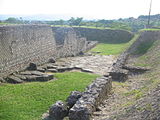
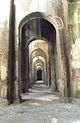
The central road
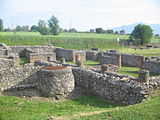
Remains of the houses (1)

Remains of the houses (2)

Side view of the thermae


References
^ (in Italian) Aeclanun on the Italian Encyclopedia Treccani
^ ab "AECLANUM (Eclano) Italy" in The Princeton Encyclopedia of Classical Sites
^ ab One or more of the preceding sentences incorporates text from a publication now in the public domain: Chisholm, Hugh, ed. (1911). "Aeclanum". Encyclopædia Britannica. 1 (11th ed.). Cambridge University Press. p. 244..mw-parser-output cite.citation{font-style:inherit}.mw-parser-output q{quotes:"""""""'""'"}.mw-parser-output code.cs1-code{color:inherit;background:inherit;border:inherit;padding:inherit}.mw-parser-output .cs1-lock-free a{background:url("//upload.wikimedia.org/wikipedia/commons/thumb/6/65/Lock-green.svg/9px-Lock-green.svg.png")no-repeat;background-position:right .1em center}.mw-parser-output .cs1-lock-limited a,.mw-parser-output .cs1-lock-registration a{background:url("//upload.wikimedia.org/wikipedia/commons/thumb/d/d6/Lock-gray-alt-2.svg/9px-Lock-gray-alt-2.svg.png")no-repeat;background-position:right .1em center}.mw-parser-output .cs1-lock-subscription a{background:url("//upload.wikimedia.org/wikipedia/commons/thumb/a/aa/Lock-red-alt-2.svg/9px-Lock-red-alt-2.svg.png")no-repeat;background-position:right .1em center}.mw-parser-output .cs1-subscription,.mw-parser-output .cs1-registration{color:#555}.mw-parser-output .cs1-subscription span,.mw-parser-output .cs1-registration span{border-bottom:1px dotted;cursor:help}.mw-parser-output .cs1-hidden-error{display:none;font-size:100%}.mw-parser-output .cs1-visible-error{font-size:100%}.mw-parser-output .cs1-subscription,.mw-parser-output .cs1-registration,.mw-parser-output .cs1-format{font-size:95%}.mw-parser-output .cs1-kern-left,.mw-parser-output .cs1-kern-wl-left{padding-left:0.2em}.mw-parser-output .cs1-kern-right,.mw-parser-output .cs1-kern-wl-right{padding-right:0.2em}
^ Aeclanum
^ Giuseppe Cappelletti, Le Chiese d'Italia dalla loro origine sino ai nostri giorni, Venezia 1864, vol. XIX, p. 180
^ Storia della diocesi di Avellino
^ Annuario Pontificio 2013 (Libreria Editrice Vaticana 2013
ISBN 978-88-209-9070-1), p. 884
 One or more of the preceding sentences incorporates text from a publication now in the public domain: Chisholm, Hugh, ed. (1911). "Aeclanum". Encyclopædia Britannica. 1 (11th ed.). Cambridge University Press. p. 244..mw-parser-output cite.citation{font-style:inherit}.mw-parser-output q{quotes:"""""""'""'"}.mw-parser-output code.cs1-code{color:inherit;background:inherit;border:inherit;padding:inherit}.mw-parser-output .cs1-lock-free a{background:url("//upload.wikimedia.org/wikipedia/commons/thumb/6/65/Lock-green.svg/9px-Lock-green.svg.png")no-repeat;background-position:right .1em center}.mw-parser-output .cs1-lock-limited a,.mw-parser-output .cs1-lock-registration a{background:url("//upload.wikimedia.org/wikipedia/commons/thumb/d/d6/Lock-gray-alt-2.svg/9px-Lock-gray-alt-2.svg.png")no-repeat;background-position:right .1em center}.mw-parser-output .cs1-lock-subscription a{background:url("//upload.wikimedia.org/wikipedia/commons/thumb/a/aa/Lock-red-alt-2.svg/9px-Lock-red-alt-2.svg.png")no-repeat;background-position:right .1em center}.mw-parser-output .cs1-subscription,.mw-parser-output .cs1-registration{color:#555}.mw-parser-output .cs1-subscription span,.mw-parser-output .cs1-registration span{border-bottom:1px dotted;cursor:help}.mw-parser-output .cs1-hidden-error{display:none;font-size:100%}.mw-parser-output .cs1-visible-error{font-size:100%}.mw-parser-output .cs1-subscription,.mw-parser-output .cs1-registration,.mw-parser-output .cs1-format{font-size:95%}.mw-parser-output .cs1-kern-left,.mw-parser-output .cs1-kern-wl-left{padding-left:0.2em}.mw-parser-output .cs1-kern-right,.mw-parser-output .cs1-kern-wl-right{padding-right:0.2em}
External links
 | Wikimedia Commons has media related to Aeclanum. |
(in Italian) Aeclanum (Cultural Property of Campania website)
(in Italian) Aeclanum (Mirabella Eclano municipal website)
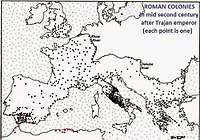
Colonies of Ancient Rome | ||||||||||||||||||||
|---|---|---|---|---|---|---|---|---|---|---|---|---|---|---|---|---|---|---|---|---|
With correspondence to modern geography | ||||||||||||||||||||
| Europe |
|   | ||||||||||||||||||
| Levant |
| |||||||||||||||||||
| ||||||||||||||||||||
Archaeological sites in Campania | ||
|---|---|---|
| Province of Avellino |
|     |
| Province of Benevento |
| |
| Province of Caserta |
| |
| Province of Naples |
| |
| Province of Salerno |
| |


